


The Central Electricity Authority (CEA) has very recently released a comprehensive plan for building evacuation infrastructure for over 76 GW of hydropower from the Brahmaputra basin in northeast India.
The overall transmission plan, has been planned in two time phases – up to 2035 and beyond 2035. The evacuation infrastructure includes hydropower plants of installed capacity greater than 25 MW as well as pumped storage projects (PSP).
Hydropower power plants of less than 25 MW capacity are termed as “small hydro plants” or SHP and come under the purview of the Ministry of New & Renewable Energy (MNRE), and not the Ministry of Power.
The total hydropower potential of over 76 GW includes around 65 GW from hydropower plants and the remaining 11 GW from PSPs, as shown in Table-1.
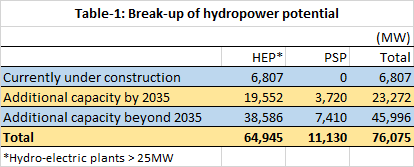

The total hydropower potential of 64,945 MW, expected to commission by 2035, will have a small share of pooling (around 6 per cent or 4,045 MW) at the intrastate transmission system (InSTS) level. The remaining will be pooled into the interstate transmission system (ISTS) network. The InSTS network for 4,045 MW will span the states of Mizoram, Nagaland, Assam, Manipur, Meghalaya, Arunachal Pradesh, Sikkim and West Bengal.
The 11,130 MW of PSP potential will be pooled at the ISTS level to the extent of 74 per cent (or 8,210 MW). The remaining 2,920 (or 26 per cent) will be pooled into the intrastate network of Assam.
Infrastructure creation
The overall evacuation plan for 76 GW envisages 31,397 ckm of transmission lines, including a majority 21,000 ckm of HVDC lines. The total substation capacity addition would be 1,09,935 MVA, inclusive of 42,000 MW of HVDC-based capacity. Details are presented in Table-2
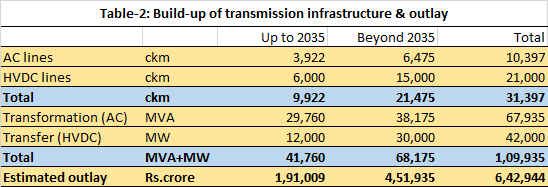

Of the total transmission infrastructure envisaged, around one-third in terms of transmission lines (or 9,922 ckm) is expected to come up by 2035. In terms of transformation/transfer capacity, the share is around 38 per cent, or 4,1760 MVA+MW in physical terms. This includes both AC and HVDC-based infrastructure.
Outlay
The CEA report estimates the total expenditure on the envisaged transmission system to be in the region of Rs.6,42,944 crore, out of which 30 per cent (or Rs.1,91,009 crore) would be spent for the pre-2035 phase. The estimated expenditure includes that on setting up new transmission infrastructure, as well as augmentation of existing substations.
Basin-wise expenditure
Of the Rs.1,91,009 crore of total expenditure envisaged up to 2035, roughly half each will be seen in the Subansiri and Dibang sub-basins of the Brahmaputra basin. Other sub-basins falling under the main Brahmaputra basin include: Lohit, Siang, Pare, Kameng, Tawang, Teesta, Barak, etc.
Major HVDC terminals
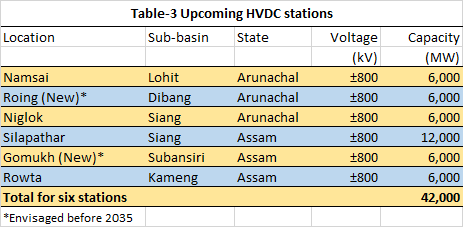
As indicated earlier, a total transfer capacity of 42,000 MW is envisaged under the comprehensive plan through HVDC stations, presented in Table-3

Also read: CEA seeks feedback from power utilities on equipment quality-related issues
Featured photograph is for representation only