


Central Electricity Authority (CEA) has released draft regulations that stipulate the presence of energy storage systems for renewable energy (RE) plants, effective July 1, 2027.
Released on September 3, 2026, these regulations called “Central Electricity Authority (Technical Standards for Construction of Electric Plants and Electric Lines) 2nd Amendment, Regulations, 2026,” shall come into force on the date of publication in the Official Gazette.
The new regulation requires all RE power plants commissioned after July 1, 2027 to have at least 15 per cent of their inverters equipped with grid-forming control and all PCS (power conversion systems) of battery energy storage systems (BESS) to have grid-forming control.
The regulations also state that all ground-mounted solar and onshore wind power plants commissioned after July 1, 2027 shall be equipped with co-located energy storage system (ESS) having a minimum storage duration of two hours and capacity equivalent to at least 10 per cent of the installed capacity of the solar/onshore wind power plant.
For instance, a solar/onshore wind power plant of 100 MW, commissioned after July 1, 2027, will need minimum energy storage of 10 MW for two hours (or 20 MWh).
Progressive stringency
The draft regulations further state that all solar and onshore wind power plants commissioned during the period from July 1, 2029 up to June 30, 2031 shall be equipped with co-located ESS with minimum storage of four hours and capacity equivalent to at least 10 per cent of the installed capacity of the solar/onshore wind power plant.
Thus, for instance, a solar/onshore wind power plant of 100 MW, commissioned between July 1, 2029 and June 30, 2031, will need minimum energy storage of 10 MW for four hours (or 40 MWh).
Periodic review
The CEA guidelines further stipulate that any change in the percentage of requirement of grid-forming capabilities or ESS capacity will be notified from time to time.
Grid-forming inverters
Grid-forming inverters are a pivotal technology in the transition to renewable energy systems, playing a critical role in stabilizing and managing power grids with high shares of converter-based resources. Unlike conventional grid-following inverters, grid-forming inverters can establish and regulate grid voltage and frequency, making them indispensable in scenarios with low system inertia or even in entirely inverter-based grids.
These inverters are essential for enabling the integration of distributed energy resources (DERs), such as photovoltaics, wind turbines, and energy storage systems, into the grid. Their ability to provide virtual inertia, support islanded operations, and stabilize weak or isolated grids makes them an advanced solution for modern power systems.
The successful deployment of grid-forming inverters requires rigorous testing, validation of their interoperability with existing and future grid infrastructure, and the development of detailed models to understand their dynamic behavior under various scenarios. [Source: International Smart Grid Action Network (ISGAN), iea-isgan.org/grid-forming-inverter/]
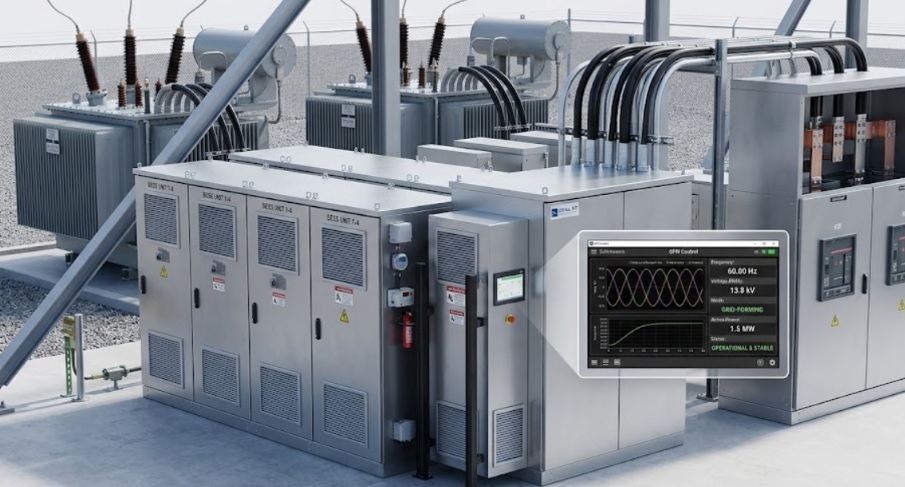
Featured photograph (source: opal-rt.com) showing a grid-forming inverter is for representation only