


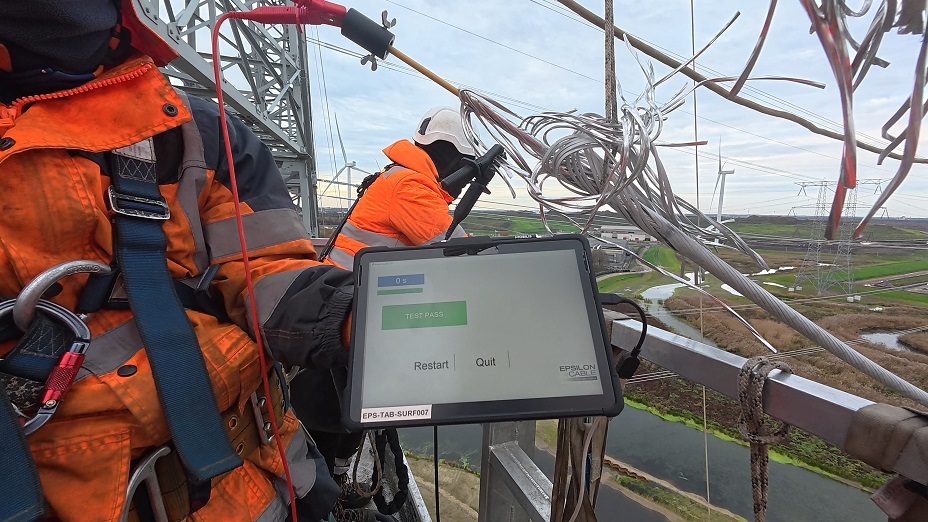
Epsilon Cable’s composite core integrity monitoring technology, CORECHECK, was successfully validated in real installation conditions on a 380kV transmission line, a release by Epsilon Cable said.
The transmission line is part of Dutch transmission system operator TenneT deploying HVCRC composite core conductors on a large scale, through frame agreements with Epsilon Cable’ stranding partners Nexans and De Angeli Prodotti. This, in turn, is part of Tennet’s 2045 objectives to support the accelerating energy transition,
Composite core conductors can be sensitive to improper handling during transport and installation, while no practical field method has historically been available to verify their internal integrity. CORECHECK addresses this gap by enabling direct verification of the structural integrity of HVCRC composite cores at every stage of a project.
CORECHECK relies on a breakdown voltage test to detect internal defects and damage within the composite core. The method leverages the insulating properties of the glass fiber outer layer of the composite core to assess the integrity of the entire core.
Also Read: Exclusive tndindia.com interview with Alexandre LULL, Managing Director, Epsilon Composite
Because it is based on a well-established inspection principle in the electrical industry, the test is familiar to operators and requires minimal training.
The system is designed for field use: each test takes approximately five minutes per conductor and can be performed by a single operator using lightweight equipment, without disrupting installation schedules.
The integrity of the composite core was verified throughout the project lifecycle: after pultrusion of the core by Epsilon, after conductor stranding by Nexans, upon delivery of conductor reels on site, and after installation by the EPC.
Testing was performed under demanding field conditions, including strong winds, dense fog, heavy rain and sub-zero temperatures, and proved compatible with complex configurations such as the presence of nearby energized parallel circuits, the release added.