

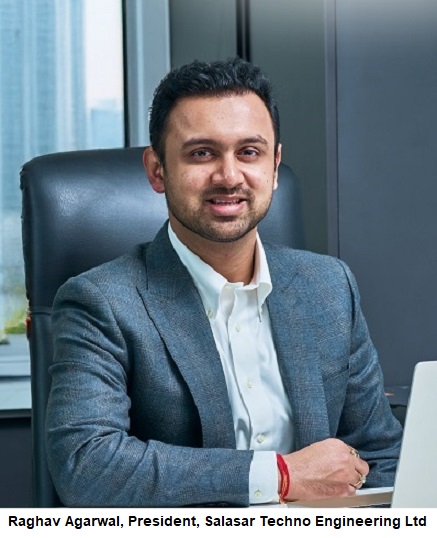
Established in 2001, Salasar Techno Engineering Ltd has evolved into a diversified, publicly-listed infrastructure powerhouse with deep capabilities across the entire value chain from conceptual design and precision fabrication to large-scale turnkey EPC execution. Salasar delivers mission-critical infrastructure solutions across telecom, power transmission and distribution, railways, renewable energy, and urban smart-city ecosystems. In this exclusive interaction, we have Raghav Agarwal, President, Salasar Techno Engineering Ltd, discussing the company’s capabilities and achievements in the power T&D space. From Salasar’s perspective, power transmission remains a key area of focus, given the scale of investments and the evolving requirements around grid expansion and modernization, notes Raghav Agarwal. An interview by Venugopal Pillai.

Yes, we crossed the Rs.1,000-crore milestone in 9MFY26, with consolidated revenue from operations at Rs.1,058.12 crore, reflecting strong execution across both our manufacturing and EPC verticals. New order inflow during the period stood at approximately Rs.300 crore.
Key additions during the period include orders such as the 400kV Banda–Chitrakoot corridor worth Rs.232 crore. In comparison to 9MFY25, the inflow reflects a steady uptick, driven by diversified opportunities across sectors rather than dependence on a single segment.
Our current unexecuted order book remains healthy at around Rs.2,200 crore, providing strong visibility for execution over the coming quarters
We understand that Salasar in recent months has won some landmark orders. Let us start by understanding the GIS substation order placed by Power Grid.
The GIS substation order from Power Grid Corporation of India Ltd (PGCIL) is a landmark win for Salasar and an important milestone in our substation journey. The order, worth about Rs.68.67 crore, is for a 110/22kV GIS substation at Lawspet, Puducherry, and covers design, engineering, supply, erection, testing and commissioning.
Is this the first GIS substation order won by Salasar?
While this is our first greenfield GIS project, we have previously executed GIS-related augmentation work in transmission lines. Whether one calls it our first major GIS substation order or a strategic entry into this space, the larger point is that it marks our steady progression into higher-value power infrastructure opportunities and strengthens our credentials in modern substation execution.
With land acquisition becoming a challenge even for substation projects, how do you see the prospects for GIS substations, in general? Does Salasar plan to enter the EHV GIS substation space, say 400kV?
One of the most visible structural shifts in the power T&D landscape today is the transition from conventional air-insulated substations (AIS) to gas-insulated substations (GIS). This is not merely a technological upgrade, but a direct response to a fundamental constraint: land.
With rapid urban expansion, industrial clustering, and increasing right-of-way (RoW) challenges, land acquisition has become significantly more complex, especially for substations located near load centers. In this context, GIS offers a compelling advantage, with a compact footprint that can reduce land requirements by up to 70 per cent. As a result, GIS substations are becoming increasingly relevant, especially in land-constrained urban and industrial locations where footprint, speed of deployment and reliability are critical.
As India’s network becomes denser and utilities look for compact, high-performance assets, GIS will see stronger adoption across voltage levels. For Salasar, this is a natural adjacency. We will continue to build capabilities in the substation segment and evaluate opportunities in higher-voltage GIS, including EHV applications, in a calibrated manner based on customer demand, technical partnerships and risk-adjusted returns.
We also recall that Salasar has won a major 400kV transmission line contract in Uttar Pradesh. Tell us more. What is the current status?
Yes, Salasar has secured and commenced work on a Rs.232-crore EPC order from Uttar Pradesh Power Transmission Corporation Ltd (UPPTCL) for the 400kV DC Twin Moose Banda–Chitrakoot transmission line, spanning about 130 km. It is a strategically important project because it strengthens regional transmission infrastructure in a fast-developing belt of Uttar Pradesh.
As of today, the project is progressing in line with planned timelines. We have already completed the foundation stone-laying milestone, and execution is currently underway across multiple fronts simultaneously to ensure earliest delivery. The core of our execution strategy is centered on speed with minimal disruption, which requires a shift from conventional linear project execution to a more integrated and parallel approach.
Any execution challenges that you are facing or foresee?
One of the key factors we foresee impacting execution are the extreme weather conditions in regions like Bundelkhand, particularly during the peak summer months of May, June, and July. High temperatures and heatwave conditions not only affect productivity but also require additional measures to safeguard worker health and maintain safe working environments. Apart from that, as with any large transmission corridor, the key challenges revolve around right-of-way availability, statutory clearances, access to tower locations, terrain-linked logistics, and tight coordination across multiple stakeholders. Our focus is on disciplined planning, timely mobilization and execution sequencing to keep the project on schedule
“From an execution standpoint, the industry is moving toward technology-enabled, precision-driven project delivery models.”
How do you see new technology helping in reducing the RoW requirement for transmission lines? Also, could you elaborate on modern project execution techniques that are helping build transmission lines faster?
Reducing RoW constraints is one of the most critical challenges in transmission infrastructure today, and new technologies are playing a decisive role in addressing this.
From a design and engineering perspective, there is a clear shift toward maximizing power transfer within narrower corridors. This is being enabled through:
- Compact tower designs and monopole structures, which significantly reduce the physical footprint
- Multi-circuit configurations, allowing multiple transmission lines to be carried on a single structure, thereby optimizing land usage
- Higher voltage systems, which enable greater power evacuation over limited space
- Advanced conductors such as HTLS (High Temperature Low Sag) and EL-59, which enhance current-carrying capacity and ensure efficient transmission of high loads without requiring wider corridors
In certain cases, underground cabling is also explored, particularly in urban or highly constrained geographies. However, its application remains selective due to higher costs and terrain-related challenges.
From an execution standpoint, the industry is moving toward technology-enabled, precision-driven project delivery models. Modern techniques that are accelerating execution include:
- Digital route surveys and LiDAR-based mapping, which improve alignment accuracy and significantly reduce rework
- Drone-assisted surveying and monitoring, enabling faster data capture and real-time project visibility
- GIS-based planning tools, supporting better decision-making and coordination across project stages
- Pre-engineered and modular structures, minimizing on-site fabrication time
- Optimized logistics and supply chain planning, ensuring timely availability of materials and resources
- Advanced foundation and tension stringing techniques, to significantly enhance both execution efficiency and safety standards
- Digital project monitoring tools, enabling real-time tracking, coordination, and decision-making
The future of transmission execution will be shaped by smarter design, better data and tighter on-ground coordination rather than conventional construction methods alone.
Railway electrification has been a core area for Salasar. In this context, tell us about the current projects in hand. Specifically, please discuss Salasar’s role in the newly-awarded contract, in consortium with K2 Infragen.
Railway electrification continues to be an important EPC vertical for Salasar, and we see sustained opportunity in this segment as Indian Railways upgrade capacity, efficiency and network resilience. Our current portfolio includes four ongoing railway electrification projects across key zones such as Western, Northern, and North-Western Railways, covering divisions like Ratlam, Lucknow, Ghaziabad, Delhi, and Jaipur. These projects reflect our continued engagement across diverse geographies and operating conditions, requiring consistent execution standards and coordination with multiple railway zones.
With respect to the recently awarded Rs. 262-crore consortium project with K2 Infragen, the scope relates to the Luni–Bhildi double-line section of Jodhpur Division under North Western Railway, covering design, supply, erection, testing and commissioning of 2x25kV AC traction substations, sectioning posts, sub-sectioning posts and SCADA systems.
Within this consortium structure, both partners are working in a complementary and well-defined manner, aligned with their respective strengths. Salasar’s role is focused on leveraging its execution expertise and technical capabilities in infrastructure development, while ensuring close coordination with the consortium partner for seamless project delivery.
“While RDSS is often viewed from an infrastructure upgrade lens, we see it as a holistic transformation of the distribution ecosystem.”
With respect to RDSS, would Salasar also be interested in smart metering (AMISP) mandates, apart from distribution infrastructure upgrade?
While RDSS is often viewed from an infrastructure upgrade lens, we see it as a holistic transformation of the distribution ecosystem, and that naturally includes smart metering under the AMISP model.
Execution under RDSS, especially in challenging terrains, requires specialized planning, adaptive engineering, and strong logistics coordination. With the addition of smart metering, the scope further expands into digital integration between electrical networks and IT systems, which is becoming increasingly critical.
On smart metering, we remain open-minded. AMISP is a promising area, but it requires a distinct technology, systems integration and lifecycle-services approach. Our strategy would be to participate selectively, either directly where we see execution alignment or through the right partnerships, while staying anchored to our core strength in utility-grade infrastructure delivery.
“Strategically, the acquisition of EMC Ltd is a significant capability-enhancer for Salasar.”
What is the latest with respect to the proposed acquisition of EMC Ltd? Please discuss the impact that this would have on Salasar’s power T&D EPC capabilities.
In fact, EMC Ltd has already been acquired by Salasar through the NCLT-led process. EMC became a wholly-owned subsidiary after the liquidation process closed, and in March 2025, Salasar’s board approved a scheme of amalgamation of EMC with the company, which was then filed with the stock exchanges.
Strategically, this is a significant capability enhancer for Salasar. EMC brings decades of EPC experience in transmission and distribution, strengthens our pre-qualification profile, deepens our execution bandwidth in complex projects and expands our addressable opportunity set in high-voltage transmission and substation works.
The addition of EMC’s experience enhances our ability to execute higher-voltage turnkey projects, including 765kV transmission and substation segments, while also improving our qualification strength for larger domestic and global tenders. The acquisition of EMC has already enabled us to secure the Millennium Challenge Account Nepal 400kV New Damauli – New Butwal transmission line project under a joint venture with Waiba Infratech.
Speaking of EPC projects, what is the current status of Salasar’s project in Nepal, which is the company’s first overseas EPC order, as we understand?
Salasar secured its first international EPC order worth Rs.1.43 billion from the Nepal Electricity Authority (NEA) in January 2023 for the procurement of material equipment, associated accessories and necessary installation services including design, erection, testing and commissioning of 33/11kV substations; 33kV, 11kV, 400kV lines, and distribution systems networks. The project was an important milestone establishing Salasar’s credentials in cross-border EPC execution.
The project is currently progressing in line with planned milestones. The scope spans distribution and substation works across multiple locations, and execution is being carried out in challenging terrain conditions, requiring careful coordination and adaptive on-ground planning. The focus remains on ensuring consistent execution, adherence to timelines, and building a strong operational foundation in the market.
Beyond that initial mandate, Salasar has continued to strengthen its overseas EPC presence. Currently, Salasar is executing two 110kV double-circuit transmission line projects in Rwanda for Energy Development Corporation Ltd (EDCL) of Rwanda, and a 400kV transmission line package in Nepal through a joint venture with Waiba Infratech under MCA-Nepal. These experiences are helping us build a more practical understanding of overseas execution, rather than approaching it purely as an expansion exercise.
“Our prime focus remains on strengthening our position as a high-quality EPC and execution partner across transmission, substations, renewable evacuation and allied infrastructure.”
How do you plan to further your overseas presence?
Our overseas strategy will remain measured and execution-led: we will focus on markets where there is visible infrastructure demand, strong funding visibility and room for Indian EPC players with integrated manufacturing and delivery capabilities The emphasis will remain on strengthening capabilities through existing engagements and expanding presence in a measured manner, with a clear focus on sustainability and disciplined growth.
Does Salasar, in the medium to long term, have plans of entering the power transmission development space, whether intrastate or interstate, under the TBCB framework?
TBCB is an attractive long-term opportunity because it sits at the intersection of asset ownership, transmission growth and grid modernization. At this stage, our prime focus remains on strengthening our position as a high-quality EPC and execution partner across transmission, substations, renewable evacuation and allied infrastructure. That said, as we scale further and strengthen both our balance sheet and execution platform, we would remain open to evaluating development opportunities under TBCB in a selective and disciplined manner, especially where the risk-return profile and strategic fit are compelling.
Given the massive investment planned by the government in power T&D and railway electrification, how do you see the years ahead for Salasar? What would be your main business growth drivers?
We remain very optimistic about the medium- to long-term outlook. India is entering a structural investment cycle in transmission, substations, renewable evacuation, distribution strengthening and railway electrification, and Salasar is well positioned to participate in that growth.
From Salasar’s perspective, power transmission remains a key area of focus, given the scale of investments and the evolving requirements around grid expansion and modernization. We are particularly foreseeing a growth in monopole-led transmission line projects owing to increasing RoW-challenges, and with a strong in-house monopole design team, we are well poised to cater to this demand.
Our key business drivers will be expansion in power T&D EPC, higher-value opportunities in substations including GIS, international EPC expansion, deeper participation in distribution modernisation under programmes like RDSS, along with growth in railway electrification and allied rail infrastructure.