


The volume of interregional electricity transfer declined significantly by 11 per cent year-on-year during the first quarter (Q1: April to June) of current fiscal year FY26.
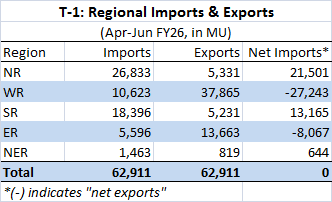

There was a sharp decline in electricity transfer across the five regional grids – northern, western, eastern, southern and northeastern (denoted as NR, WR, ER, SR and NER, respectively.)
The biggest interregional electricity transfer takes place from WR to NR (denoted as WR-NR). This component saw a transfer quantum of 23,201 MU in Q1FY26, down 15 per cent from 27,301 MU in Q1FY25. Generally, the next biggest constituent, WR-SR, also saw its metric fall 15.8 per cent from 12,953 MU in Q1FY25 to 10,907 MU in Q1FY26.
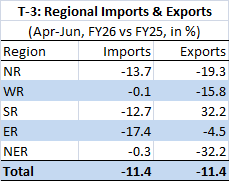

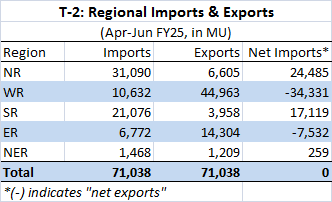
WR saw a sharp decline of nearly 16 per cent in exports, from 44,693 MU in Q1FY25 to 37,865 MU in Q1FY26. Exports from WR were stagnant across the two quarters. WR was a net exporter to a lesser extent of 27,243 MU in Q1FY26 as against 34,331 MU in Q1FY25.
Interregional transfer capacity
As of June 30, 2025, the country’s total interregional transfer capacity stood at 120,340 MW (or around 120 GW), up from 118,740 MW as of March 31, 2025. This increase of 1,600 MW was entirely due to augmentation on the ER-WR corridor, in turn due to commissioning of critical ISTS schemes by Power Grid Corporation of India Ltd (PGCIL).
Currently, the bulk of India’s total interregional transfer capacity lies on the WR-NR corridor – 38 GW out of the total 120 GW. Transfer capacities on the ER-NR, ER-WR and WR-SR corridors are roughly 22.5 GW each.
Also read: Interregional electricity transfer up 4.2 per cent in FY25
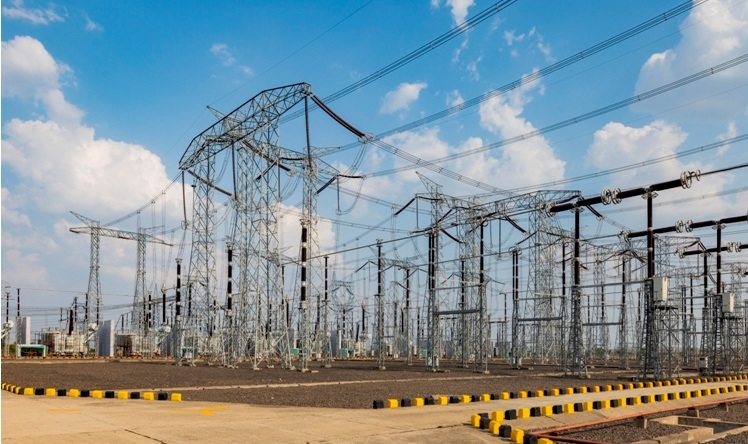
Featured photograph (source: Adani Energy Solutions Ltd) is for representation only