


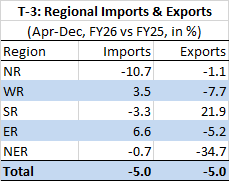
The total volume of electricity transfer across the five regional grids declined by 5 per cent, year-on-year, during the first three quarters (9M: April to December) of FY26.
According to latest data released by Grid Controller of India Ltd (GRID-INDIA), the country’s total interregional transfer stood at 1,86,140 MU (million units or million kWh or GWh) during 9MFY26 as against 1,95,848 MU in the same period of FY25.
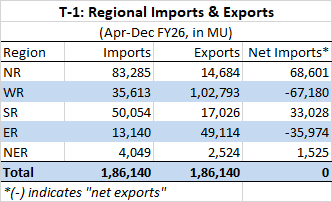

The share of WR-NR transfer in the country’s total interregional transfer also dropped from 37.3 per cent in 9MFY25 to 35 per cent in 9MFY26.
NR saw a decline in imports and exports during 9MFY26. While imports fell sharply by 10.7 per cent, exports were 1.1 per cent lower. With the result, NR was a net importer of electricity to a lesser extent of 68,601 MU in 9MFY26 as against 78,433 MU in 9MFY25.
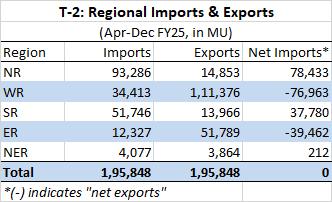
SR, a traditional net importer of electricity, showed lower dependency during 9MFY26 with a 3.3 per cent fall in imports, year-on-year. Exports from SR, on the other hand, showed a 21.9 per cent increase, rising from 13.966 MU in 9MFY25 to 17.026 MU in 9MFY26. The combined effect of these two factors saw SR becoming less of a net importer in 9MFY26, at 33.028 MU, as against 37,780 MU in 9MFY25.

During 9MFY26, India’s total interregional transfer capacity grew by 1,600 MW. All of this was added on the ER-WR corridor. This enhancement was the result of the commissioning of an ISTS-TBCB scheme housed under “Powergrid ERWR Power Transmission Ltd” in June 2025. The project involved putting up a 400kV double-circuit line from Jeypore (Odisha, ER) to Jagdalpur (Chhattisgarh, WR).
Also read: Interregional electricity exchange drops 7.3 per cent in H1FY26
Featured photograph is for representation only