


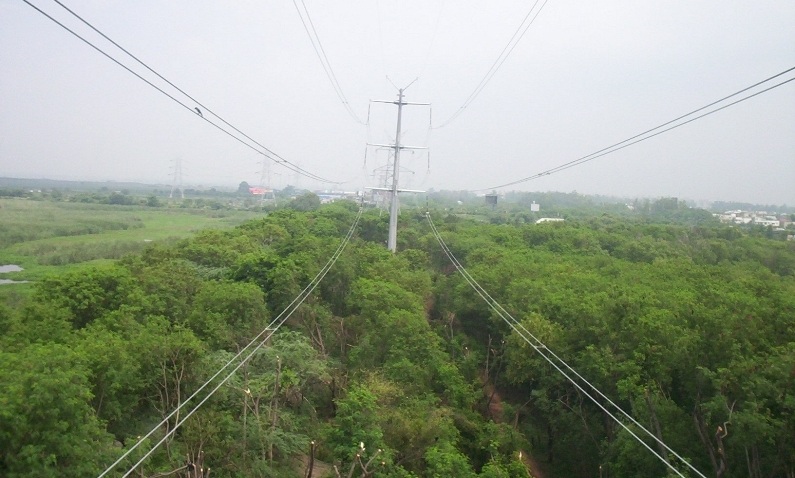
An ISTS scheme project involving re-conductoring of the existing 400kV double-circuit Lara STPS-I to Raigarh (Kotra) transmission line in Chhattisgarh has been approved for implementation under the regulated tariff mechanism (RTM) framework.
To be executed by Power Grid Corporation of India Ltd (PGCIL), the project involves re-conductoring of PGCIL’s existing 400kV double-circuit Lara STPS-I – Raigarh (Kotra) line with twin HTLS conductor with minimum capacity of 2,100 MVA per circuit, at nominal voltage. The line has a running length of around 20 km.
The project also involves upgrade of the existing wave trap associated with two 400kV bays at the Raigarh (Kotra) end of the aforementioned line, from 2000A to 3150A.
Besides, four 400kV bays at the Lara-I STPS end of the said line will also be similarly upgraded from 2000A to 3150A. However, this component will be executed by NTPC Ltd, the owner of the switchyard associated with its Lara-I super thermal power station (STPS). This will involve upgrade of current transformers (CT) and isolator from 2000A to 3150A, as well as upgrade of existing connectors, jumpers, etc to match with the upgraded reconductoring capacity.
The overall project cost is an estimated Rs.100.53 crore, out of which NTPC’s component would cost Rs.41.08 crore.
This ISTS scheme is officially termed as “Scheme to resolve high loading on Lara STPS-I – Raigarh (Kotra) 400kV D/C line” and has an implementation period of 18 months – 15 months on best effort basis. NTPC is expected to commission its component in a timeframe matching that of PGCIL’s.
Scheme objective
The main objective of the scheme is to resolve high loading on the 400kV double-circuit Lara STPS-1 – Raigarh (Kotra) line in Chhattisgarh. There are two scenarios of power flow on this line:
- From Lara STPS-1 to Raigarh (Kotra) when there is high WR-SR transfer on the Raigarh-Pugalur HVDC line and low WR-NR transfer on the Champa-Kurukshetra HVDC line
- From Raigarh (Kotra) to Lara STPS-1 when there is high SR-WR transfer on the Raigarh-Pugalur HVDC line and low WR-NR transfer on the Champa-Kurukshetra HVDC line
In both the scenarios, there is N-1 non-compliance on the Lara STPS-1 – Raigarh (Kotra) line that could be addressed by the re-conductoring project discussed in this story.
Featured photograph is for representation only