

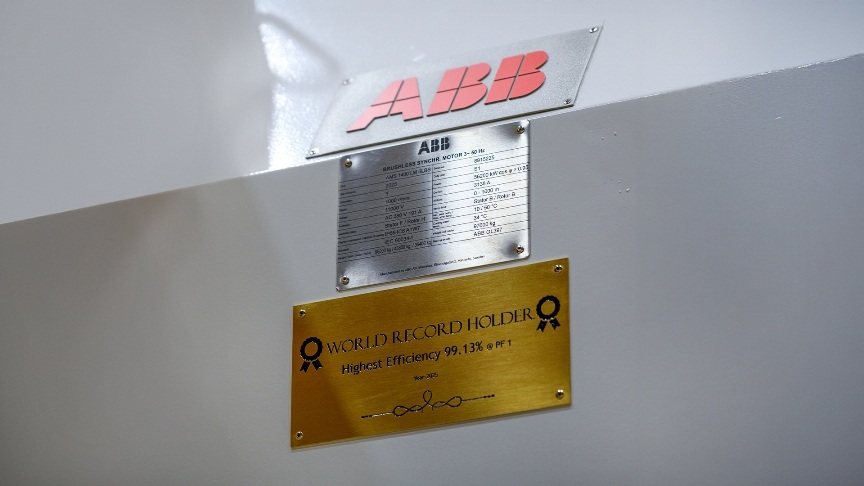
In May 2025, ABB set a new benchmark in industrial energy efficiency by surpassing its own world record for efficiency in large synchronous electric motors. Developed under ABB’s Top Industrial Efficiency (TIE) program, the new 56MW motor – destined for a major steel producer in India achieved a verified 99.13% efficiency under IEC testing standards. David Bjerhag, Global Business Line Manager, High Speed Synchronous Motors at ABB Motion High Power, explains the concept of energy efficiency and the methods used to measure it.


Energy efficiency has evolved from a design consideration to a defining global priority, shaping everything from household devices to the infrastructure that powers economies. Fundamentally, it measures how effectively input energy is converted into useful output. In electric motors, it reflects how much of the power drawn from the grid becomes mechanical output at the shaft, rather than dissipating as heat or vibration.
The implications are global: electric motors consume nearly half of the world’s electricity. In heavy industries, where energy use is both the largest cost and the main lever for CO₂ reduction, even small improvements in efficiency deliver measurable financial and environmental returns.
The new world record isn’t just an engineering milestone but redefines what is technically and economically achievable in energy-intensive industries.
Every fraction counts
For electric motors, the equation is straightforward: Efficiency (%) = (Output Power ÷ Input Power) × 100
Input power is the electrical energy supplied to the motor, while output power is the usable mechanical energy delivered at the shaft to drive equipment such as compressors, pumps, and fans. The concept may be simple, but the implications are immense. The “missing” portion of input power is not vanishing into thin air, but manifests as heat, vibration, and friction. Reducing these losses is the fundamental challenge of motor design.
Given the volume of energy that electric motors convert into motion, even incremental gains deliver significant results. Consider ABB’s improvement from 98.6% to 99.13% efficiency. It may seem marginal at first, but for a continuously operating multimegawatt motor, that fraction translates into millions of dollars saved over its lifetime. Equally important, it prevents tens of thousands of tons of CO₂ emissions, demonstrating how small improvements can yield major financial and environmental returns.
Understanding where losses happen


Improving efficiency starts with a thorough understanding of motor losses. Four principal categories determine industrial motor performance.
Resistive losses (I²R) occur within the copper windings, where electrical resistance (R) converts the current (I) into heat. Core losses occur in the stator and rotor structures, driven by magnetic hysteresis and induced eddy currents.
Mechanical losses arise from bearing friction and air resistance (windage) as the rotor spins at high speed. Finally, stray load losses represent lesser inefficiencies caused by uneven magnetic flux distribution when the motor is under load.
High-efficiency motor designs focus on each category directly. ABB engineers address each area systematically through a combination of increased copper content, premium electrical steels, optimized geometry, precision winding, and tight manufacturing tolerances. The result is a measurable reduction in waste energy and a notable enhancement in power density and operational reliability.
Meticulous measurement
While the efficiency equation is straightforward, proving it is anything but. Applying it in practice requires meticulous testing under strict international standards.
Two standardized approaches dominate industrial testing:
- Direct method: This approach measures the motor’s output torque and rotational speed using a dynamometer while simultaneously recording the electrical input. The resulting ratio provides an immediate, accurate measurement of the motor’s efficiency.
- Indirect method: Calculating individual losses (resistive, core, mechanical, stray) and deriving efficiency from their sum subtracted from total input power.
Both testing approaches are regulated by IEC 60034 and NEMA standards, ensuring results are traceable and comparable across manufacturers. Every ABB motor rated above 3 MW undergoes rigorous verification before shipment. The record-setting 56 MW unit for India met these stringent criteria, earning full IEC certification for its 99.13% efficiency.
Verification is critical because efficiency figures can’t just be impressive in theory; they must be validated, certifiable, and credible.

Real world value
The business value of improved efficiency matches the technical breakthrough in every aspect, as illustrated by the results at the Indian steel plant. The project will help save more than 61 GWh of energy and nearly USD 6 million in avoided electricity costs projected over 25 years. Environmentally, the gains are just as striking, with 45,000 tons less CO₂ emitted, roughly the same as taking 10,000 cars off the road for a year.
Equally important, the economics and sustainability goals align seamlessly. Most customers recover any additional upfront cost early in the motor’s lifetime, after which every hour of operation delivers ongoing financial returns. Lower operating temperatures further extend equipment life, amplifying both economic and environmental value.
Efficiency as a strategy
Energy efficiency reaches beyond day-to-day operations – it shapes corporate strategy. At its core, it creates value across four dimensions.
First, it advances sustainability by cutting greenhouse gas emissions and accelerating progress toward climate goals. Second, it drives cost optimization by reducing energy use and maintenance needs, lowering the total cost of ownership over the asset’s lifetime. Third, it strengthens talent and culture, reinforcing a company’s environmental commitment and engaging employees who want to contribute to a purposeful organization. And lastly, it builds investor confidence by improving resilience to energy price volatility and future carbon costs.
The International Energy Agency (IEA) calls efficiency the “first fuel” of the energy transition. It represents the fastest, most cost-effective path to decarbonization, with clear benefits for both profitability and planet.
Raising the bar
While official IE3–IE5 efficiency classes currently apply only to motors below 1 MW, industrial customers are increasingly seeking verified, high efficiency performance in much larger power ranges.
To help close this standards gap, ABB created the Top Industrial Efficiency (TIE) initiative, a framework that offers certified, transparent, and commercially validated efficiency options for the world’s largest motors. By making performance measurable, comparable, and verifiable, the TIE option helps customers prioritize lifecycle value over upfront cost and design options, a vital step toward long term performance and resilience.
The continuous pursuit of efficiency
In essence, energy efficiency is the art of achieving more with less, and proving it through credible, data driven validation. Reaching 99.13% efficiency proves that the boundary between technical possibility and commercial viability is thinner than ever.
However, efficiency is more than a milestone; it’s a way of thinking, a continuous journey of refinement, precision, and imagination. Each fractional gain fuels greater competitiveness and resilience, moving the industry toward a cleaner, more sustainable future.
(Note: To discover how ABB’s Top Industrial Efficiency solutions set new benchmarks in performance and sustainability, visit this dedicated landing page.)