

US-based TS Conductor produces the patented and award-winning “TS Conductor” that offers a highly efficient, reliable and cost-effective alternative to conventional power conductors. TS Conductor recently formalized partnerships with two conductor manufacturers in India, paving the way for the company’s entry in the subcontinent. In this exclusive interaction, we have Jason Huang, Founder & CEO, TS Conductor, discussing how TS Conductor, thanks to its superior qualities, can help India build a resilient, efficient and sustainable power grid. An interview by Venugopal Pillai.


We note with appreciation that TS Conductor has named Diamond Power Infrastructure Ltd as its stranding partner. Does this represent TS Conductor’s entry in the subcontinent?
TS Conductor is working with two stranding partners in the Indian market: Diamond Power Infrastructure Ltd and Laser Power & Infra Pvt Ltd. These partnerships were both solidified recently, in Spring 2025.
Broadly, what was the rationale behind entering the Indian market?
India’s power sector is undergoing rapid transformation, driven by increasing demand, renewable energy integration, and grid modernization initiatives. However, several challenges persist, including high transmission & distribution (T&D) losses, aging infrastructure, land constraints, and extreme weather conditions. TS Conductor can provide an innovative solution tailored to address these unique challenges, offering a more efficient, reliable, and cost-effective alternative to traditional conductors. More specifically:
High T&D Losses: India faces transmission losses of nearly 20 per cent, significantly higher than global standards, leading to financial strain on discoms. TS Conductors have lower electrical resistance, leading to a significant reduction in power losses. Their increased efficiency translates to lower operational costs and improved financial viability for discoms.
Renewable Energy Integration: The ambitious target of 500 GW of non-fossil fuel capacity by 2030 requires robust transmission networks to evacuate power efficiently. With higher ampacity, TS Conductors enable efficient power evacuation from solar and wind farms, supporting India’s renewable energy goals.
Aging Infrastructure: Many existing transmission lines struggle to handle increased power loads, necessitating urgent upgrades. The TS Conductor’s improved lifespan and durability reduce maintenance and replacement costs and its higher power transfer capacity means fewer new lines are required, preserving ecological balance.
Land and Right-of-Way (ROW) Issues: Securing land for new transmission corridors is a major hurdle, particularly in densely populated and environmentally sensitive areas. Using TS Conductors, existing transmission lines can be upgraded without expanding ROW, reducing land acquisition hurdles and accelerating project timelines.
Climate Resilience: Extreme weather conditions, including high temperatures, monsoons, and cyclones, demand stronger and more durable transmission solutions. Minimal sag allows for better performance in high-temperature regions like Rajasthan and Gujarat. The TS Conductor is designed to withstand high temperatures, heavy monsoons, and extreme wind loads, making them ideal for India’s diverse climatic conditions.
Are the agreements with Diamond Power and Laser Power exclusive, in the sense that the two Indian partners free to have similar tie-ups with other companies?
This agreement is exclusive to both the partners for their defined markets.
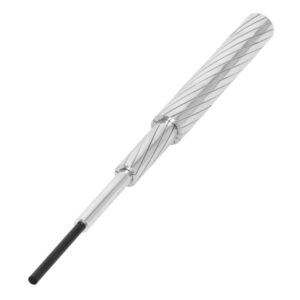
We broadly understand that TS Conductor makes energy-efficient “TS AECC” conductor cores. What is the composition of these cores from a physical perspective?
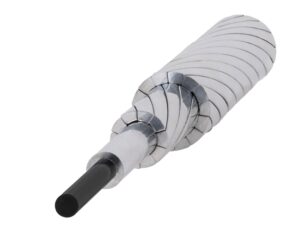

The fundamental limit in unidirectional composites, such as composite cores for conductors, is the compression vulnerability from bending because the (axial) compression strength is a matrix material dominated property, typically only 60-70 per cent of its tensile strength. The pre-tensioned carbon core helps to prevent the onset of compression failures during bending, because the built-in tension in the core has to be overcome before getting into compression.
The aluminum encapsulation layer also serves multiple functions: providing mechanical cushioning that enables the use of standard compression fittings and installation methods, and creating a seamless environmental barrier that protects the carbon fiber from moisture, oxygen, and other degradation factors throughout the conductor’s service life. Annealed aluminum outer strands and their trapezoidal wire design also help to maximize conductivity, reduce wind resistance, and provide natural damping through creep and inter-strand friction, protecting against fatigue damage.
How do conductors equipped with these cores compare with conventional conductors, say ACSR for instance, in terms of current-carrying capacity?
Thanks to their unique composition, AECC conductors deliver 2-3 times the capacity of ACSR conductors using the same structures, with half the line losses, while maintaining low thermal sag at high operating temperatures. The ability to achieve this increased capacity without structure modifications or replacements provides utilities with a cost-effective option, too.
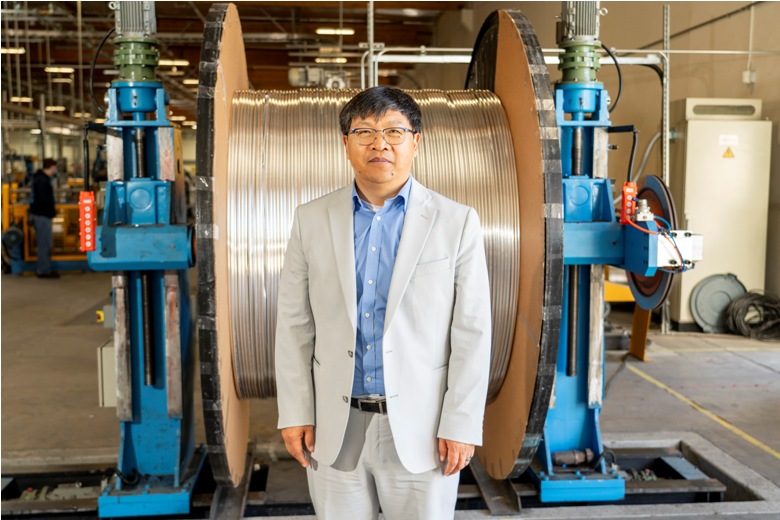

Tell us in brief about TS Conductor’s global presence. Which regions/countries are you currently present in, and which is today your biggest market?
The US remains a key market due to federal funding and urgent grid modernization needs, which is why TS is present across the US today. Beyond that, Europe, Asia Pacific, and Latin America markets are highly attractive to TS.
Europe is driven by stringent climate policies, aggressive decarbonization targets, and an aging power grid that requires upgrades. Asia Pacific has rapidly growing electricity demand, new infrastructure development, and governments prioritizing energy efficiency. And Latin America is another promising region, with increasing investments in renewable integration and grid expansion.
We presume that AECC cores are manufactured solely in your US facility. Is that so?
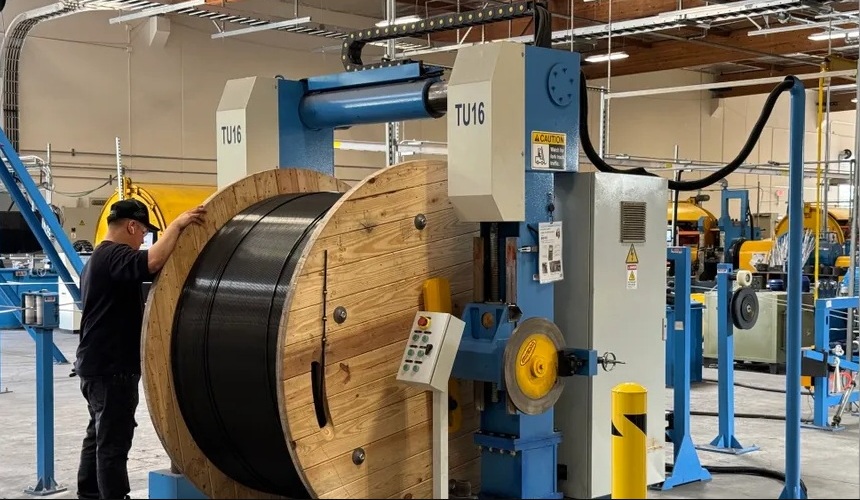
Yes, AECC cores are currently manufactured in our Huntington Beach, California facility, and will soon also be produced at our new facility in Hardeeville, South Carolina.
In India, would you be looking largely at the reconductoring market, or new-build as well?

In India, many existing transmission lines struggle to handle increased power loads, necessitating urgent upgrades via reconductoring. The TS Conductor’s improved lifespan and durability reduce maintenance and replacement costs and in new-builds, its higher power transfer capacity means fewer new lines are required, preserving ecological balance.
By integrating the latest advancements from the outset, TS technology helps their markets “leapfrog”, ensuring long-term efficiency and sustainability.
On a technical note, up to which voltage (kV) can TS AECC conductors cater to?
TS Conductors are designed for high-voltage power transmission lines. They have been used in projects operating at 220kV, 330kV, and 345kV.
How do you gauge the Indian market with respect to acceptance of HTLS conductors, given that the capital cost would be on the higher side and much of the Indian power grid is still in the hands of government utilities?
The Indian market is gradually accepting HTLS conductors for high capacity corridors, driven by ROW constraints and renewable integrations. TS products, however, have superior performance in span, sag, durability, and live-line operations. The core encapsulation, weight-to-strength ratio, sag reduction capabilities, and lower losses outperform the first generation of advanced conductors, including HTLS conductors. TS technology leverages the best materials for conductors, enabling design with protection of the core (designed-in safety, reliability and longevity) and ease of use (with traditional work practice).

Given that India has pledged to invest a very substantial amount in its power transmission infrastructure, how do you see the road ahead for TS Conductor in the subcontinent?
With India’s massive transmission investment push and focus on renewable integration, the road ahead for TS Conductors looks promising in this region — especially for upgrading congested corridors and long-span renewable evacuation.
TS Conductor’s technology can align with key government programs and policies, making it an ideal choice for modernizing India’s power sector:
Revamped Distribution Sector Scheme (RDSS): Focuses on reducing losses and improving efficiency in discoms.
Green Energy Corridor (GEC): Aims to enhance transmission capacity for renewable energy projects.
National Infrastructure Pipeline (NIP): Supports large-scale power sector investments, including transmission upgrades.
Make in India & Atmanirbhar Bharat: Encourages local manufacturing and technological advancements in power infrastructure.
Specific opportunities for TS involvement in India include:
Renewable Energy Corridor in Rajasthan
- Solution: TS Conductors can be deployed to reconductor existing lines, doubling capacity without expanding ROW.
- Outcome: Increased power evacuation efficiency, reduced transmission losses, and accelerated project completion.

Urban Grid Modernization in Mumbai
- Challenge: High energy demand and aging infrastructure led to frequent power losses and load constraints.
- Solution: TS Conductors can replace conventional conductors, enhancing power transmission without major infrastructure overhauls.
- Outcome: Improved reliability, lower transmission losses, and reduced maintenance costs for utilities.
Cyclone-Resilient Transmission in Odisha
- Challenge: Frequent cyclones disrupted power supply due to damaged transmission lines.
- Solution: TS Conductors’ high-strength composite core and superior resilience can be used to replace conventional lines.
- Outcome: Reduced storm-related outages, faster restoration, and enhanced grid reliability.
Perhaps not in the medium term, but would you consider India as a manufacturing base for TS AECC cores?
Indian and Asian markets are rapidly growing and TS Conductor’s expansion plans are currently under evaluation.