

Ceiling fans are amongst the most widely used appliances in an Indian household, alongside tube lights and bulbs. The cumulative impact of switching to 5-star-rated energy-efficient fans is significant, and the switch from conventional induction-motor fans should be made sooner than later, according to this explainer article by Alliance for an Energy Efficient Economy (AEEE), authored by Balendu Bhushan Pandey, Mrinal Saurabh Bhaskar and Supriya Gulati.
On a sweltering April afternoon in Gurugram as the temperature crossed 40 degrees Celsius, the power bill shocked Sneha before the relief of the ceiling fan could. A working mother juggling deadlines and rising household costs, the math had quietly stopped adding up. The old fan in her living room ran continuously with a not-so-melodious whir, and still the room felt heavy with heat, while the electricity meter spun faster than ever. The daytime work calls were becoming difficult to manage with the noise, and she had to switch to AC to avoid the disturbance, even though she really did not need it at that time of day.
It was not a big decision at first, just a practical one. She replaced just one fan with a 5-star-rated, energy-efficient model featuring brushless direct current (BLDC) technology, on a friend’s recommendation.
A month later, the difference was hard to ignore.
The fan ran silently through work calls and provided a better sleep-time experience for the family. The remote operation was a bonus, enhancing the ease of use. And when the next electricity bill arrived, it carried a small but noticeable shift: more comfort, less cost. What began as a single swap soon turned into a quiet household transition. Today, Sneha’s home runs three 5-star-rated energy-efficient fans, and the reduction in the electricity bill was a reminder of how small a decision it took to make the change.
Across Indian cities where ceiling fans run almost year-round through hot days and increasingly warming night times, thousands of similar, almost invisible decisions are adding up, one household at a time, into a story about energy efficiency that doesn’t start with policy, but with people.
Due to their widespread use, ceiling fans account for a significant portion of household electricity consumption. During peak summer months, they can account for approximately 30-40 per cent of a home’s total electricity consumption.
The challenge is not only the high usage, but the performance of these fans, which consume more and more energy with every passing year of use, increasing the consumer’s electricity bill.
In India, approximately 450-500 million ceiling fans were reportedly installed in homes by 2023[1], and the numbers on the ground would be much higher now. Approximately 50-60 million new fans are sold each year[2]. Most conventional ceiling fans in India use induction motor technology. These induction ceiling fans, particularly those older than 7 years, consume around 70–90 watts of power.
In contrast, newer energy-efficient ceiling fans use BLDC (Brushless Direct Current) motors, which use electronic controllers and permanent magnet motors, which reduce power losses and optimise motor efficiency. That is why energy-efficient fans consume only 25-35 watts per hour and deliver the same airflow and comfort. A sharp saving of 50-65 per cent in energy use and, eventually, in cost. Icing on the cake – conventional fans consume same energy at different speeds. Energy-efficient fans using BLDC consume fractional energy at lower speeds.
Since ceiling fans in Indian homes run for long periods and in many rooms almost 24 hours a day, the overall energy savings are significant. A conventional fan running at 75W costs a household roughly ₹2,250 a year at 15 hours of daily use, and up to ₹3,600 if it runs round the clock in a home in North India (Assuming a fan runs for these number of hours for approximately 250 days a year, considering typical fan usage during warmer months March to October (8 months) in North India, with limited usage in winter). A 5-star-rated energy-efficient fan with BLDC technology drawing just 30W cuts those figures to ₹900 and ₹1,440 respectively, at the same ₹8-per-unit electricity rate. That is a saving of 60 per cent, year after year, from a single switch.
The table below shows a simplified comparison, assuming a fan runs for approximately 15 hours a day and, in some rooms, nearly 24×7, for approximately 250 days a year (considering typical fan usage during warmer months March to October (8 months) in North India, with limited usage in winter) in a home in North India.
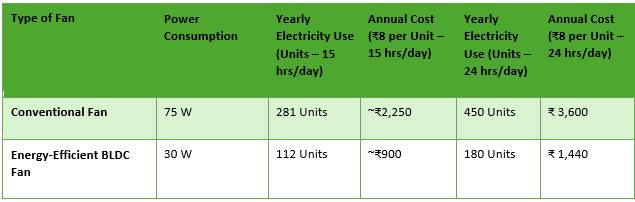

A 5-star-rated energy-efficient BLDC fan can save approximately 170-270 units of electricity per year per household, depending on usage, resulting in annual savings of approximately ₹1300 – ₹2,000, depending on usage patterns. Although these fans are costlier than conventional fans, with a retail price beginning from around ₹2,000 and above, their lower power consumption adjusts the additional cost within one to two years through savings on electricity bills.
How to choose an energy-efficient fan?
Consumers should consider the following factors while buying a BLDC Fan:
Check the BEE Energy Efficiency Star labelling. 5-star-rated energy-efficient fans come with BLDC technology. Note that star labelling for ceiling fans is now mandatory in India, so any fan sold without a star label is illegal. Verify the veracity of the label at the BEE star label portal (https://www.beestarlabel.com/) or app.
Check the fan specification on power consumption: Energy–efficient fans consume only 25-30 Watts per hour
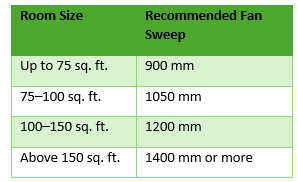
- Does the fan provide adequate air delivery and airflow? Look for CMM (cubic metres per minute) or CFM (cubic feet per minute) rating on the packaging. It tells the volume of air the fan moves per minute. For a room size of 100-140 sqft, a CMM value ≥ 210 is ideal.
- Energy-efficient BLDC fans always come with additional features such as remote control, timers, or smart connectivity. If the seller does not share this, be cautious.
- What is the warranty and after-sales service? Compare with other brands and choose the best option. 5-star-rated energy-efficient fans have advanced technologies that are generally low maintenance.
- Most important: consumers should check that the current setup of the electrical supply and system is compatible with the energy-efficient BLDC fan[4]. BLDC fans need to be connected with a wall switch, but should not be connected to the usual fan regulator. Bypass the regulator during installation to avoid damage to the fan. Use remote or app.

Why should you switch now?
Ceiling fans are amongst the most widely used appliances in an Indian household, alongside tube lights and bulbs. The cumulative impact of switching to 5-star-rated energy-efficient fans is significant. Large-scale adoption of energy-efficient fans could reduce electricity demand by 6-8 billion units annually, easing pressure on consumers and the power system.
As temperatures rise and electricity bills follow, the everyday fan is no longer a background appliance; it’s a decision worth a second look. The next time one gives out, or a new room needs one, that choice is simpler than it seems.
About the authors: Balendu Bhushan Pandey is Senior Research Associate, Alliance for an Energy Efficient Economy (AEEE); Mrinal Saurabh Bhaskar is Program Lead – Industrial Energy Efficiency and Decarbonisation, AEEE, and Supriya Gulati is Lead-Communications, AEEE.