


A further delay of around three months is likely in awarding contracts for the mega Ladakh HVDC project that Power Grid Corporation of India Ltd (PGCIL) has been mandated to develop under the regulated tariff mechanism (RTM) modality.
Addressing an investor conference on PGCIL’s Q1FY26 performance, R.K. Tyagi, Chairman & Managing Director, PGCIL, said that it could be another 3-4 months before contracts for the mega Ladakh HVDC scheme are awarded.
It was earlier expected that contracts would be finalized in Q2 (July to September) of FY26, but the process could now be pushed to Q3 (October to December).
Explaining the reasons for delay, the PGCIL CMD said that so far only one EPC contractor (name undisclosed) has expressed interest in the Ladakh project that will see the use of VSC-based HVDC technology. Even here, the supplier has expressed apprehension on whether HVDC technology would be feasible at a project location that is over 4,000m (4 km) above sea level.
PGCIL expects to discuss the matter with the sole HVDC OEM supplier in question and finalize the issue over the next two months, before potentially awarding the contract.
Officially known as “Green Energy Corridor (GEC) Phase-II – Inter-State Transmission System (ISTS) for 13 GW Renewable Energy Project in Ladakh,” the Ladakh HVDC project envisages 713 km of transmission lines (including 480 km of ±350kV HVDC line) and two HVDC terminals — each at Pang (Ladakh) and Kaithal (Haryana).
The Ladakh HVDC project is estimated to have a project outlay of Rs.20,000 crore out of which around Rs.12,000 crore will be for the HVDC terminal stations and the balance for the transmission line.
HVDC or EHVAC
While this discussion is underway, the Central PSU is also evaluating the option of employing conventional AC power transmission technology. Tyagi explained that VSC-based HVDC technology would be best suited for the Ladakh-Kaithal scheme but if it is technically infeasible to use HVDC, the option of AC transmission will need to be evaluated.
Even in the case of AC transmission, there are technical complexities. Given that the Ladakh-Kaithal scheme would involve evacuation of renewable (solar) energy, the AC transmission system would need significant dynamic reactive compensation, and the use of synchronous condensers and STATCOMs, Tyagi explained. This will significantly add to the capital cost of the project.
The PGCIL CMD further pointed out that synchronous condensers have not been used so far in India, and this could be an added technological challenge during project execution.
In summary, the Ladakh-Kaithal transmission scheme is grappling with unresolved issues, regardless of the transmission technology – HVDC or EHVAC.
Clarity will emerge only in coming months. If the concerns expressed by the HVDC supplier are satisfactorily addressed, the contract can be finalized over the next three months or so.
If, on the other hand, the possibility of HVDC is discontinued and the option of AC transmission is pursued, the award of contract could be pushed much further.
HVDC capacity
India’s current capacity of HVDC-based power transmission infrastructure stands at 19,375 ckm of lines and 33,500 GW of transfer capacity. While only 80 ckm and 1,000 MW of new addition is likely between now and end-FY27, the projected addition during the five-year period FY28 to FY32 is a significant 15,432 ckm of lines and 32,250 MW of transfer capacity. By end of FY32, going by these plans, India’s cumulative HVDC-based capacity would be in the region of 34,887 ckm and 66,750 MW, standing for transmission line network and transfer capacity, respectively.
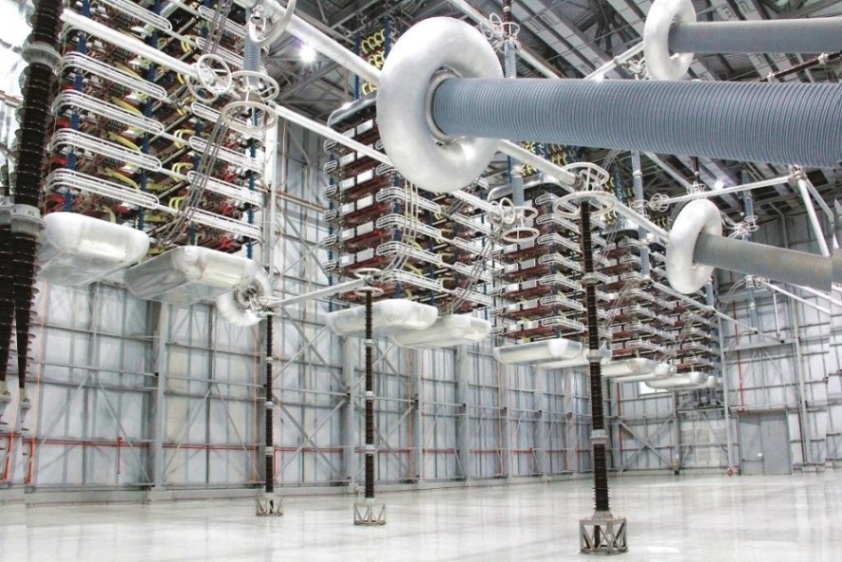
Featured photograph (source: GE Vernova T&D India Ltd) is for representation only