

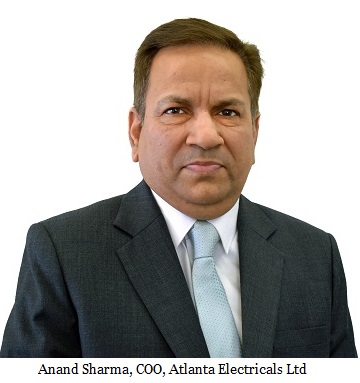
On the cusp of a massive upgrade, India’s power transmission sector is providing immense business opportunity to developers, contractors and equipment suppliers. However, signs of supply chain crunch are being felt, particularly with respect to high-voltage transformers where the envisaged demand is far in excess of current supply. In this exclusive interaction, we have Anand Sharma, Chief Operating Officer, Atlanta Electricals Ltd, sharing his views on supply chain-related issues, from the perspective of a leading transformer manufacturer, in conversation with Venugopal Pillai. While Sharma feels that Indian transformer makers are responding very positively to the situation by way of capacity expansion and backward integration, the situation can be improved through better planning and coordination among stakeholders.

Yes, there are challenges for sure. This is because the transformer requirement surge has come as a surprise to all. Having said this, I must say that the Indian transformer industry has done a good job over the past couple of years, in terms of building capacity. Atlanta Electricals may be among the early movers to set up a greenfield plant and acquire another company, to expand its overall capacity.
From the perspective of EPC contractors, I would say that while transformer manufacturers are expanding capacity and reducing production cycle times, customers also need to plan their requirements well in advance. These two must work in conjunction.
The demand surge in not restricted to the Indian market; it is global. The shortage is being felt across the world, not only in transformers but also in critical transformer components. Component manufacturers are also expanding capacity to address this gap. I don’t say that this situation will start to ease off immediately, but the demand-supply situation will begin to look comfortable in the medium run.
Has CEA made it mandatory for 400kV transformers to undergo short-circuit test?
Yes, mandatory short-circuit (SC) test for 400kV transformers is a not a very recent guideline; it has been around for at least two years. CEA has issued this guideline to ensure that only quality players enter the 400kV transformer business. Since 400kV and 765kV are highly critical voltage classes, the short-circuit test is an effective way to assess a manufacturer’s engineering and manufacturing capability.

Assuming that transformer manufacturers are willing to do the SC test, how many of them do have the inhouse facilities to do it?
The SC test is a special test, not like routine tests under IS 2026. In practice, a lot of manufacturers across the globe may not have in-house facilities to do the SC test, however large the manufacturer may make an exception. The good thing is that in India we now have the Bina laboratory (of NHPTL) which can do the SC test up to 765kV.
Earlier, Indian manufacturers had to rely on overseas labs like KEMA for getting the SC test done. That is no longer the case now, as we have the test facility available in India itself.
What is your take on backward integration moves by the Indian transformer industry in general?
Transformer manufacturers, I would say, are responding positively. When there is business available on the table, this is the time to make most of it!
Each manufacturer will have its own set of challenges. For instance, if my company is facing shortage of CTC (continuously transposed conductors), others might not. So, every manufacturer is taking its own call on backward integration, depending on its specific constraints and budget.
In the case of Atlanta Electricals, we have decided to put up a greenfield facility for fabricating tanks and radiators. This will be done in a year’s time. Others may be putting up a plant for conductors, bushing and other components.
What has been the impact of the ongoing tensions in West Asia?
The obvious and direct impact of rising crude oil prices has been on the cost of transformer oil. However, there are other items in the background that are getting impacted. For instance, prices of gaskets, paints, thinners, solvents have risen sharply.
Small fabricators that do not have access to laser or plasma cutting lines, rely on a mix of LPG and oxygen for metal cutting. They have been hit hard by the LPG price hike.
Now, natural gas (PNG) is also used for upcasting of copper and aluminium wherein scrap is melted and recast into rods or bars. Shortage of gas is impacting such players as well.
Though the degree of impact will differ from manufacturer to manufacturer, the impact, per se, cannot be ruled out. The effect on transformer prices will depend on the extent of input cost increase. For example, a sharp rise in gasket prices may not materially affect transformer prices, but a 50 pe cent increase in transformer oil prices would have a substantial impact.

How is Atlanta Electricals protected by increase in transformer prices?
In our case (Atlanta Electricals), most of our contracts are with Central/state governments where we are protected by the price variation (PV) clause devised by industry body IEEMA.
Our business strategy therefore provides us with a cushion against price volatility of components and commodities. However, we will be affected in case of delays in the supply of raw materials.
But in terms of pricing, since we have this PV formula to support us, commercially we are not facing much of a problem.
Coming back to the mandatory SC test, do you have any policy suggestions to reduce the lead time for transformer procurement?
I think as an industry we could devise alternative methods to validate the quality of design of transformers. In a world where information technology is being increasingly leveraged, advanced software is now available to assess whether a transformer design is SC-worthy or not.
For the next couple of years, say, some alternate route could be considered where physical SC test is relaxed to some extent and greater reliance is placed on software-based validation.
I completely agree that producing 400kV or 765kV transformers is a highly specialized job, participation from companies also requires infrastructural knowledge. Qualification criteria are essential, but they should not become barriers. Other suitable mechanisms can certainly be explored.

Allowing transformer imports from China is being discussed in policy circles. What is your view in this regard?
This is a very sensitive subject. If I speak from the transformer manufacturers’ point of view, I may not completely support the import of fully assembled transformers from China. If you go and talk to the component manufacturers, they also would not be very comfortable with the idea.
Therefore, the issue should be handled very carefully and in a way that benefits the country as a whole. If there is real shortage in the country and we are not seeing domestic capacity increasing, and in such a case, if capacity or supply can be made available from China, then we may temporarily import to bridge the gap.
What is truly commendable in this respect is the kind of intent and speed at which domestic transformer manufacturers are showing, in putting up newer facilities or adding capacities.
How can a transformer manufacturer address the supply crunch situation from an operations angle?
If suppliers require support, that requirement should be catered. If we have 12 months of order visibility, we should share that with our respective vendors instead of placing requirements at the last minute. The same logic applies to customers. If transformer requirement is huge and there is an expected supply crunch, then in such a case, it is always better to book manufacturing slots well in advance.
If manufacturers share their plans with suppliers in advance, I think much of the problem can be reduced. This is the time where everybody should be working collectively, rather than in silos. This is how we will be able to have a winning combination.
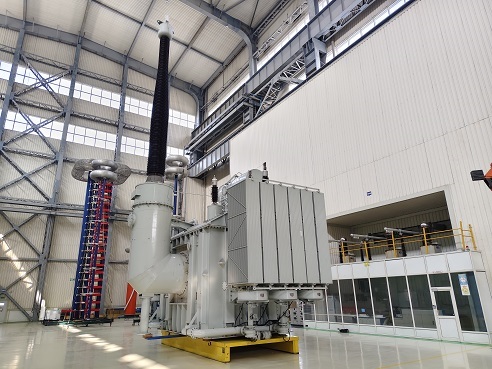
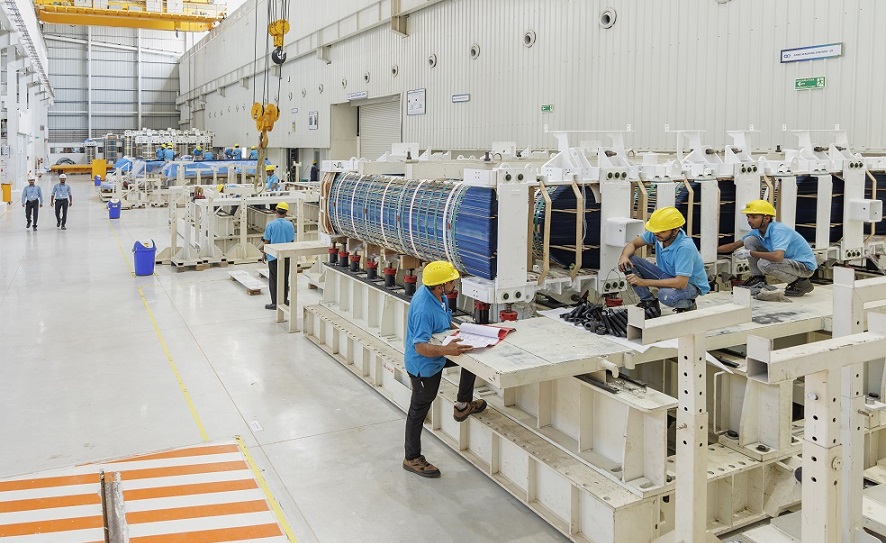
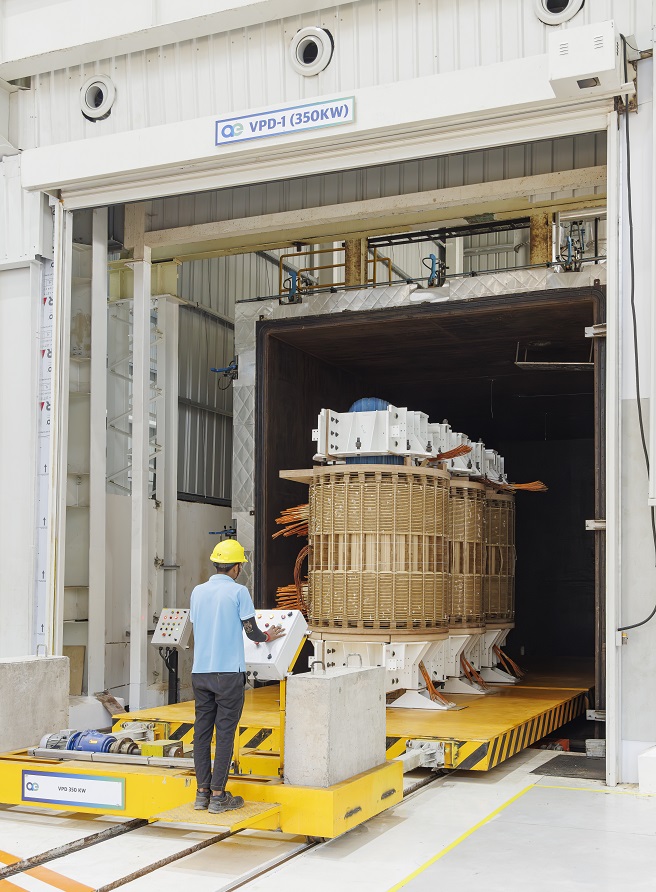
All industrial images seen in this interview relate to manufacturing/testing facilities of Atlanta Electricals Ltd and have been used for illustration only.