


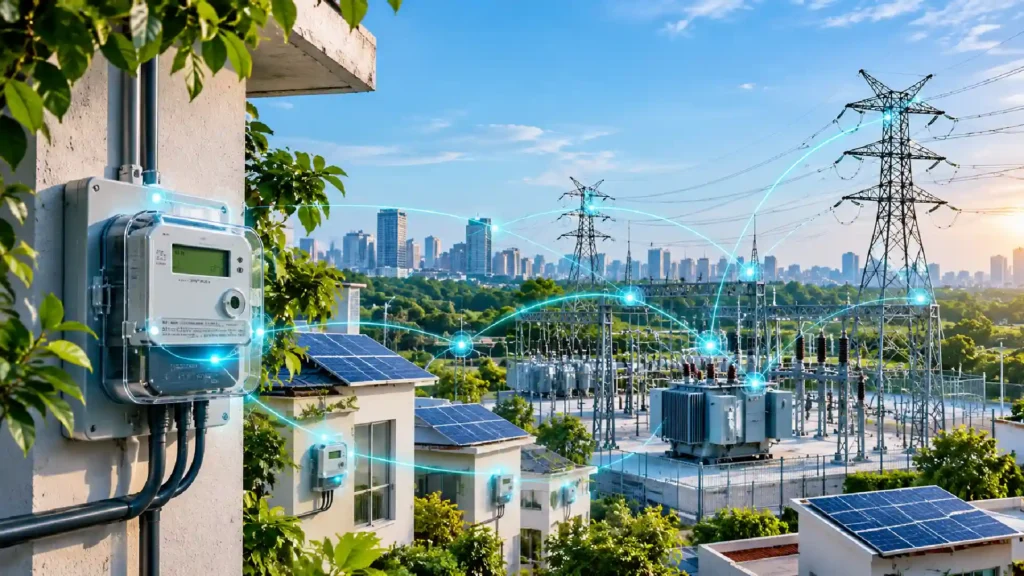
The Telecommunications Standards Development Society, India (TSDSI) has formally adopted DECT-2020 NR – widely known as NR+ – as a national standard, establishing an indigenous framework for non-cellular 5G connectivity across smart grids and large-scale metering networks.
Originally developed by the European Telecommunications Standards Institute (ETSI) and recognized by the International Telecommunication Union (ITU) under its IMT-2020 5G framework, NR+ is built for dense machine-to-machine communication. Unlike conventional cellular networks, it runs on licence-exempt radio spectrum-eliminating the need for cell towers, SIM cards, or recurring telecom operator contracts.
Instead, NR+ relies on a self-healing decentralized mesh where individual meters relay data through neighbouring units. If one link drops, traffic automatically reroutes through adjacent nodes, keeping large field deployments online without manual intervention.
The standardization comes midway through India’s nationwide smart metering push. Ministry of Power data shows 7.24 crore smart meters were installed across the country by June 30, 2026-including 5.73 crore under the Revamped Distribution Sector Scheme (RDSS), where 20.33 crore units have been sanctioned toward a broader 25-crore national goal.
Finnish IoT connectivity specialist Wirepas, which announced the adoption on November 16, 2026, noted that over 12 million smart meters in India already run on its NR+-based software, including a single mesh network linking more than one million meters.
For power distribution companies (discoms) and advanced metering infrastructure service providers (AMISPs), TSDSI’s sign-off changes how communication hardware is procured. Until now, utilities specified radio-frequency mesh networks through vendor-specific certifications and performance benchmarks. Having an official Indian standard allows discoms to mandate open, interoperable connectivity in tenders, reducing single-vendor lock-in and shielding 10- year meter contracts from commercial telecom network shutdowns.
Commenting on the development, Teppo Hemiä, Chief Executive Officer of Wirepas, said the adoption represents an important milestone for India and the NR+ ecosystem. He noted that the technology has already been deployed across challenging Indian operating environments and that the new standard could allow utilities and system integrators to specify decentralized connectivity in their tenders.
Ashish Sahay, Sales Director and Country Manager, India, at Wirepas, said the adoption could change how communication technologies are specified in smart metering tenders. According to him, the use of an Indian standard could help reduce vendor dependence and support interoperability across different components of the advanced metering infrastructure ecosystem.
The move also opens doors for domestic semiconductor designers to integrate NR+ stacks into Indian-made radio chipsets, building on earlier standards alignment between the Bureau of Indian Standards (BIS) and ETSI. Outside power utilities, the standard is backed globally by industrial players including Schneider Electric, Siemens Smart Infrastructure, and Legrand for smart building and factory automation networks.