

Gujarat-based Atlanta Electricals Ltd is a longstanding home-grown transformer manufacturer that has to its credit an enviable record of having supplied transformers of up to 220kV to utilities spanning 19 states and three Union territories. With the acquisition of the BTW-Atlanta plant in 2025, AEL is now in an even more commanding position to tap opportunities in the 765kV class. AEL is also aiming at 1,200kV and HVDC as India’s power grid evolves. In this exclusive interview, we have Niral Patel, Chairman & Managing Director, Atlanta Electricals Ltd, in conversation with Venugopal Pillai, sharing the company’s growth plans, whilst providing deep understanding on critical industry-related issues.


How has AEL’s journey shaped its current position?
Our journey really began in 2010 when we entered the 66kV class, but the intent was always clear: to progressively move the value chain into 132kV, 220kV, 400kV and ultimately 765kV. The BTW acquisition in August 2025 is not a tactical deal; it is the culmination of a long, patient execution cycle that proves our preference for systematic capability building over opportunistic growth.”
What impact do you see of BTW Atlanta, your erstwhile joint venture, now coming into the Atlanta Electricals fold?
BTW-Atlanta represents our vision that we always had — moving to higher kV class. Atlanta Electricals, per se, was always good at absorbing new technology, developing new technology. But when we were in 66kV, we wanted to take a leap towards 400kV and 765kV.
In 2010, we initiated the joint venture and formalized it in 2011. Unfortunately, the markets then were not good. We could begin construction in 2016, after a waiting period of around five years. In 2018, construction was complete.
The primary goal of Atlanta was still that – entering the 400kV and 765kV class – either by ourselves or through a JV or through buying technology.
This company BTW-Atlanta, per se, was a separate company altogether. There was a clear understanding that Atlanta Electricals will not enter the 400kV or 765kV territory. Similarly, BTW Atlanta would not enter the 66kV, 132kV or 220kV class.
There was a clear demarcation, supported by a territory non-conflict clause. We did not want our customers to get confused!
Tell us more on how the takeover of BTW-Atlanta came about.
The last order shipment of BTW-Atlanta was in 2022. When the company shut down, we persuaded them to sell it off – either to us or somebody else. There was no sense in leaving the company and its infrastructure as it is.
Being a China-government company, they had their own restrictions. The procedure to sell an offshore asset was quite tricky. In fact, BTW-Atlanta was among the early offshore assets owned by the China government. Finally, in 2024, they got approval for the sell-off.
We always had the intention to buy. We were regularly undertaking capital expenditure at Atlanta Electricals so we knew the positive impact the machinery available at BTW-Atlanta could have.
We had a financial bid in mind for a potential takeover of BTW-Atlanta but we did not get positive feedback from BTW. Independently, BTW was trying to sell the plant but did not find buyers then.
Fortunately, Indian markets went up, and so did the demand for EHV transformers. Our competitors also starting quoting for the plant, which gave BTW a benchmark price!
We received the ROFR (right of first refusal) in early 2024 to which we gave our acceptance and the deal was eventually concluded.

What is the current ownership structure of BTW-Atlanta?
BTW Atlanta Transformers Pvt Ltd was incorporated in 2012 as a 90:10 joint venture between Baoding Tianwei Baobian Electric Co (BTW) of China and Atlanta UHV Transformers LLP, the promoters of Atlanta Electricals Ltd.
BTW Atlanta Transformers Pvt Ltd, after its acquisition in August 2025, has been renamed to Atlanta Trafo Pvt Ltd, which is wholly-owned subsidiary of Atlanta Electricals Ltd. This subsidiary can be merged with the parent company after a cooling period of one year.
What is your broad vision for the BTW-Atlanta plant?
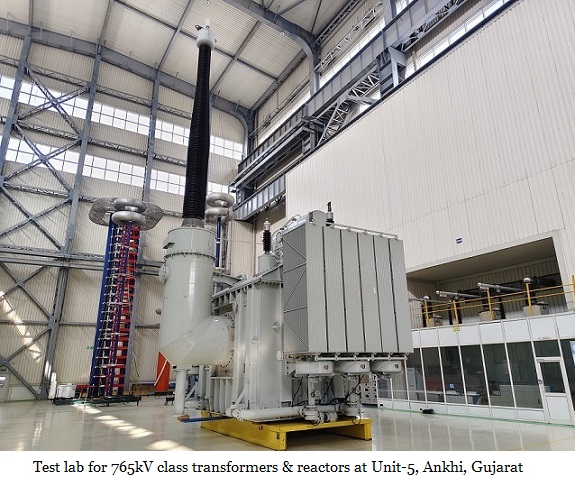
Our vision is to definitely come in the market with 765kV transformers. The BTW-plant, located at Jambusar, near Vadodara, is a 765kV mass-producing facility that has provisions that can upgrade to 1,200kV. When I say provisions, I mean without making civil changes. Only equipment would need to be added. Most importantly, testing facilities already exist. In fact, the BTW-Atlanta factory was designed to make even 1,200kV equipment.
Has there been any transfer of knowhow from BTW?

However, can Atlanta convince a customer for long-term supply of 765kV transformer? The answer is difficult to give because the customer will naturally be apprehensive.
We can convince people that the technology transfer is done. Perhaps, one or two private players could be convinced. But when it comes to state utilities or say PGCIL, a tech tie-up would be required.
Those kind of tech tie-ups are what we are working on. It is not just about technical knowhow, it is more about the license to use the partner’s technology, and the references of the technical partner.
If we tie up with, say, a party in Ukraine that has supplied 600 numbers of 765kV class transformers, the license of using their experience comes to the Indian market. This gives our customers confidence.
Have a you shortlisted partners for the proposed technical tie-up?
We have shortlisted three partners, including from China. At the technical or legal level, there is no problem with China as there is going to be no shareholding. Very frankly, it is difficult to deal with China, for the language barrier and for other reasons. We have multiple options but will keep China as the last option.
Any targeted timeframe?
Possibly, before end of March 2026. That is what we have in mind. These things will come with a technical tie-up with somebody that wants to enter the market with 765kV. A GE or Siemens will not sell me technology!
We understand that Ukraine is known for 765kV transformer technology.
Yes, Ukraine is the original story. ZTR was the first organization. Anybody and everybody that went into 765kV had connections with Ukraine. But, see in those times, in early 2000s, when these discussions happened, ZTR was most accessible. After that, there are many companies that are now available for 765kV – some are famous, others are not so well known.
Do you have any capacity expansion at BTW-Atlanta plant?
The capacity that we have in 66kV, 132kV, 220kV and 400kV is sufficient and we have no expansion plan in this range. In 765kV, with the current capacity of 15,000 MVA (at the BTW-Atlanta plant) we will never achieve economies of scale.
We originally planned to expand by 15,000 MVA in three stages. This expansion will kick in when we enter the 765kV class.
Looking at the current market lead time – domestic and export –we can complete the expansion and definitely catch up with the opportunity.
When BTW-Atlanta was operational, did it produce 765kV class transformers?
Yes, we have supplied a 765kV reactor. To make a 765kV class reactor (as opposed to a transformer), is a whole different ball game. There we need 900kV-class testing equipment infrastructure.
BTW-Atlanta largely catered to the domestic market – PGCIL, state utilities of Gujarat and Telangana, besides some private players.
We see several transformer manufacturers undertaking backward integration to shorten their production cycle? Do you have such plans for Atlanta Electricals?
Talking about backward integration, supply chain management is one of the issues and quality is the second-biggest. You may end up getting the material on fast-track basis but when you are looking at exports markets, or in corrosive environment within India, this quality does not survive.
We say 30 years is the thumb-rule of transformer longevity. However, the exterior might not last that long even if the interior does! So, our backward integration plans are mainly focusing on quality issues. If I demand that quality from existing suppliers, the cost will be humungous. We might as well put up a facility generating more or less that kind of quality, using robotics, say, at the same price.
Atlanta would be focusing on tank fabrication and radiator fabrication; these are the first victims of corrosion. Once these two projects kick in, we will move to conductor fabrication – CTC (continuously transposed conductor) or PICC (paper insulated copper conductor).
Besides, if you have your own conductor fabrication facility, the transformer repair market becomes a very lucrative business. India will have significant amount of copper conductor availability in future. So, supply chain management will not be so much of an issue, but cost will be.
That is our vision for backward integration.
Tell us about the in-house testing facilities of Atlanta Electricals.

The short-circuit test is a one-off test. SC test labs are never ever part of OEM’s facility as they need enormous amount of power, as well as capex.
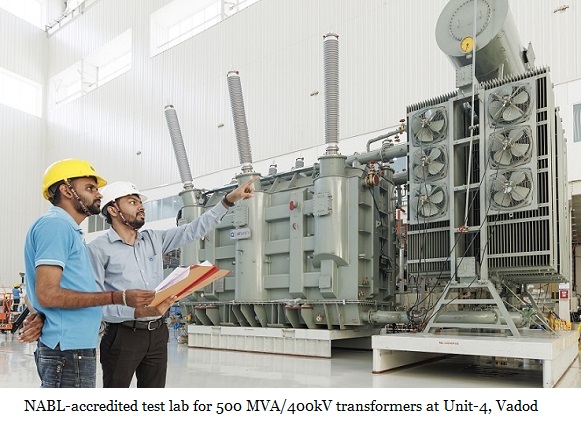
For 765kV tests, there are routine tests specified by the transformer. Usually, all OEMs would be doing this inhouse. When we say in-house, the capex is huge. You have to have intermediate transformers, generators, etc. The time to set up test labs is very long, and you also need to get NABL certification. Setting up manufacturing facilities, on the other hand, do not take so long!
All routine tests, even for 765kV, are possible at the BTW-Atlanta plant. For 1,200kV, the same testing equipment will need to be upgraded. So much of the capex at BTW-Atlanta plant will be on the testing.
Testing is one of the major bottlenecks, when you enter into manufacturing. Each transformer needs to get tested twice –internally, and in the presence of customer.
What about testing facilities available at Indian labs?
Globally, we are better placed. For instance, NHPTL can do short-circuit tests for 400kV transformers.
Atlanta Electricals is largely Gujarat-based. How did the Bengaluru unit come into the fold?
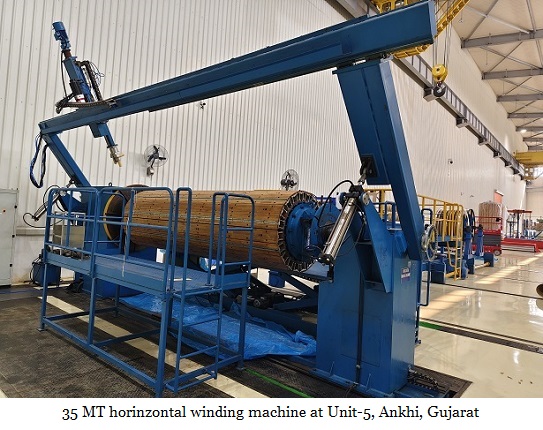
The story is that we had Unit-1 at Anand as our pilot unit. The first 63kVA distribution transformer got manufactured there. The first 220kV/160 MVA, the biggest that we currently make, was made there. It is a pilot plant. Any research development that we do, we will get it done there. Slowly, the plant expanded and is now capable of 220kV. When we started 220kV in 2018, it was in Unit-1. We carved out a separate unit for 66kV and 132kV, which is Unit-2, also at Anand.
Later, we were fortunate enough to find a transformer company in Bengaluru who wanted to exit the business. This became our Unit-3.
In 2023, we knew we would run out of capacity for 220kV, so a brownfield expansion was done in Unit-1 to enhance capacity.
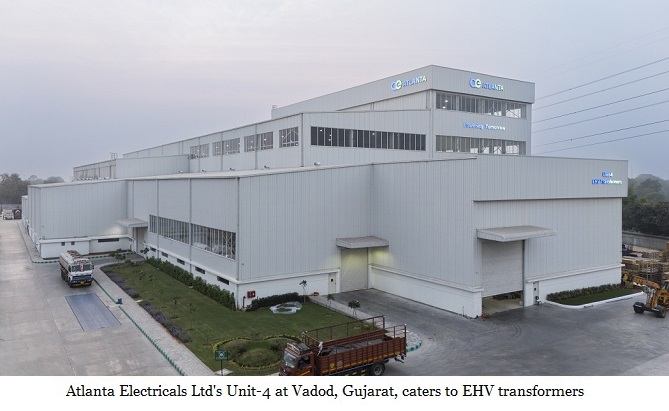
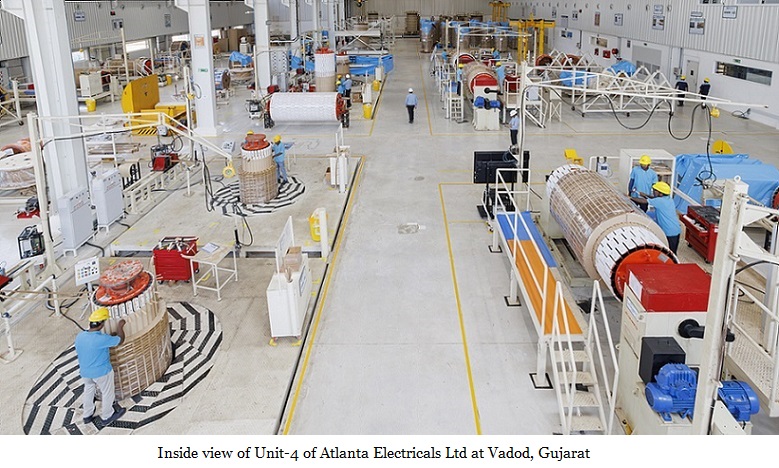
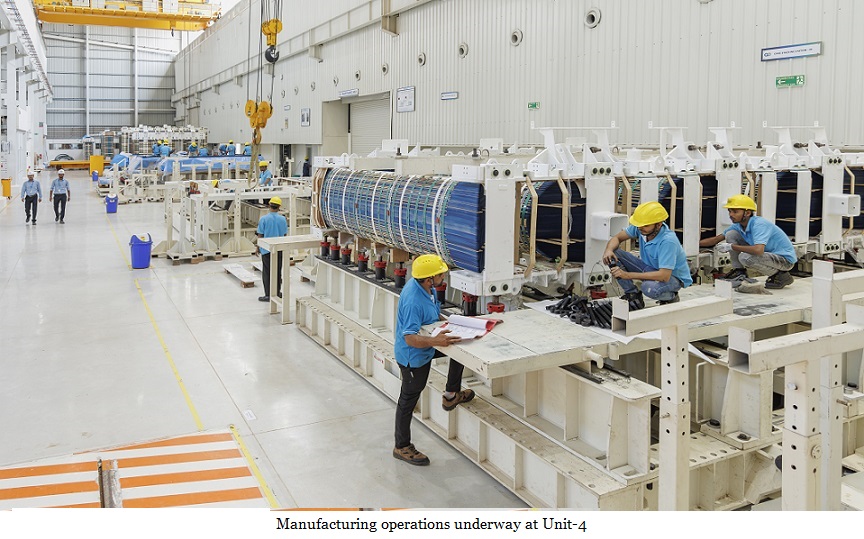
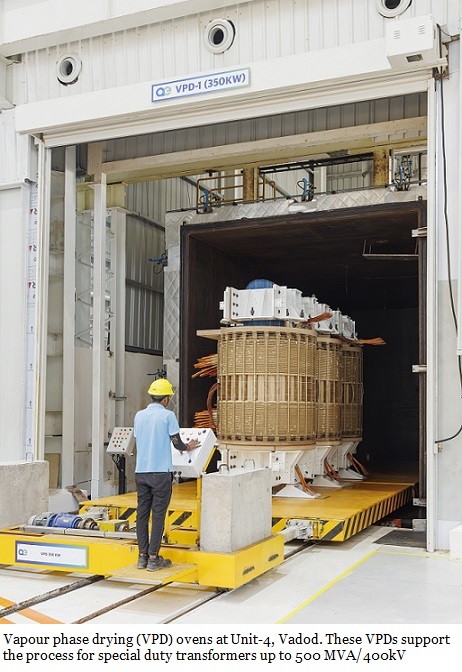
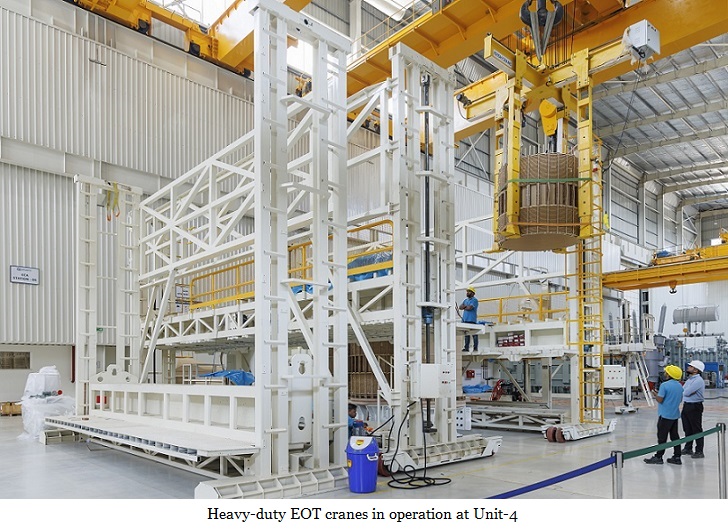
A new greenfield plant at Vadod, which is Unit-4, was born in 2025 for 220kV and 400kV transformers.
An OEM prefers to have separate manufacturing facilities to serve different kV classes. For a 400kV unit say, making 220kV is fine and so is 132kV, to some extent. Below that, say 66kV, the overhead costs will increase. For instance, you need air-conditioned facilities for 400kV but air-cooling is fine for 66kV.

Tell us more on how Atlanta Electricals expanded its market footprint beyond home state Gujarat.
Gujarat Energy Transmission Company Ltd (GETCO), the state utility of Gujarat, has been an organization with which we started our journey. GETCO has been supportive throughout and it is so today as well. From 2017-18, we started looking at different markets, within India.
Since then, till today, we have served 255 customers across 19 states and three Union territories, with transformers up to 220kV.
We have supplied to all major states like Uttar Pradesh, Haryana, Madhya Pradesh, Punjab, Tamil Nadu, Karnataka, Rajasthan, Kerala, Andhra Pradesh, Telangana, Bihar, Jharkhand.
We will start our journey to the northeast perhaps this year. Apart from northeast, we have yet to tap West Bengal.

To start with, we would be looking at unregulated markets like African markets, Bangladesh, Nepal and ME – where exports markets exist in the kV class range that Atlanta Electricals has knowhow. We were fortunate enough to secure an order in Nepal recently. Our core focus, for exports, would be 220kV or below.
Our unexecuted order book should have 15 per cent exports; that is our long-term goal. We still have a two-year timeline for a exporting 132kV transformers. The company has a dedicated export wing and trying to capitalize on opportunities.
Our longstanding experience with GETCO helped us tap 19 states and Union territories in India. Now, we want to use our experience in India to tap global markets.
How is China as a competitor to Indian companies in the exports market?
Yes, China is a competitor. We also faced competition from China in our Nepal order. But customers are also looking now at China+1. We have to be cost-competitive.
To compete in 66kV and 132kV segment (exports), it is always better to have your design and production teams continuously innovating because changing very fast. In the case of 400kV and 765kV, things might not change that fast. Requirements are also not such that changes would be warranted.
But in lower ratings, technology is evolving fast. Innovation and a desire to continuously evolve will help you make your product cost-effective. For instance, if you have automated lines – though it is capital intensive – the production time goes down. You save on interest cost.
Chinese players have government support that helps then to scale up. They also have the advantage of export incentives. However, markets are also now positive; they have China+1 and sometimes insist on not buying from China.
There is nothing that China can do and we in India cannot do!

Given that you are active in both the domestic and global markets, how are you building Atlanta Electricals for scale and resilience?
We have designed our facilities and capacities to grow without disruption—modular MVA expansion, upfront provisions to move from 400kV to 765kV and even 1,200kV, and multiple in-house test labs to ensure that testing never becomes a bottleneck.
At the same time, we are deepening vertical integration in tanks, radiators and conductors, not just to control quality over a 30-year lifecycle but also to create a strong, recurring repair and services revenue stream.
Coming back to industry issues, it is often argued that procurement policies of state power utilities are flawed, thanks to the L1 criterion. What is your take?
The L1 story remains but things are not so bad!
To start participating in the tenders of 132kV, 66kV and 220kV of state government utilities, you need to have plant approval done by the specific utility. If not plant approval, you need to commit that you will conduct the short-circuit test as per specifications for the utility. Once you have committed that, you will be able to start supplying on a regular basis.
L1 has been the mantra for the entire procurement policies of India, be it power utility or any other government organization. Will it change or not; that is something we don’t know.
People want to maximize their production; make good products; keep quality consistent. All this is because customers today are intelligent; they know the meaning of good quality.
Utilities are now opting for green transformers with synthetic or natural ester oil. Is there any pressure on OEMs to go green?

Utilities are trying to use synthetic ester oil. GETCO, for that matter has been instrumental in doing newer things, such as mandated use of RIP bushings or using ester oil, etc. GETCO was always at the forefront of taking such landmark decisions. Other state utilities are also trying to fall in line.
Maharashtra, for instance, has guidelines that all inverter duty transformers will be ester oil-filled. So, a private player also will need to buy ester oil-filled IDT.
Atlanta has done this seven years ago. One of our 100 MVA transformer filled with natural ester oil is running successfully on one of the GETCO sites. Ratings of 10 MVA and 15 MVA are also running successfully at GETCO.
PGCIL has also started to procure 400kV transformers with ester oil.
Green transformers represent a trend that has recently started. It is therefore the duty of the OEM to be ready. When we say ready; it is terms of our mindset as well as infrastructure. We have done this 7-8 years ago, and there are hundreds of ester oil transformers made by Atlanta, in the field. Our advantage therefore is that we are already experienced in the field.
How do such green transformer compare with conventional ones, in terms of cost?
In terms of cost, ester oil transformers are significantly more expensive that mineral oil-filled ones.
What is your take on the shift from OIP bushings to RIP bushings?
Yes, the shift from OIP bushings to RIP bushings is also picking up. There used to be one manufacturer for RIP bushings in India, now we have four. The other good news is that everyone has started expanding. They laid their expansion plans a year or 18 months back. Those plans are getting into shape, and possibly, in another six months’ time, we will see the expanded capacity come into play, bridging the demand-supply gap.
Does Atlanta Electricals have plans of entering dry transformers for metro rail or distribution transformers?
We would like to restrict ourselves to power transformers. Our Unit-2 can offer 66kV and 132kV transformers but we are also doing 33kV there. Recently, we have started a small capex of 5,000 MVA in the 33kV class. We don’t want go below that!
On the mobility segment, we are already an approved vendor by RDSO. We are executing good amount of orders for TSS (traction substation). We certainly would like to expand our presence by way of developing and supplying transformers like Scott-connected, V-connected and auto transformers, which has become the new norm for transportation sector and railways.
Metro rail projects need smaller-rating transformers; it is an area that we would rather not like to enter.

What about newer types of transformers?
We do make furnace transformers. We have the knowhow. We have also supplied a large number of inverter duty transformers (IDT) to Adani Green Energy. We are optimistic of growing demand of specialized transformers for railways and data centres. In the renewable energy space, there is demand for pooling transformers for solar and hybrid (solar+wind) power plants, as well as generation step-up transformers.
What impact do you see of private players entering power transmission?
When you start dealing with private players, quality specs differ. When private players operate, they have to ensure that substations or solar power plants are well maintained. They will therefore ensure that they order quality products. Incidentally, 30 per cent of our orders come from private players.
Does an OEM like Atlanta Electricals influence transformer specifications, especially private players?
In the Indian or any foreign market, for an OEM to suggest specs to a certain extent is alright. We can guide customers on the specs. They are very open to suggestions. After all, it is not that they are going to talk only to us! We suggest the specification; they build it in their requirement, and the bidding happens. That creates a fair bidding market, and that is a good shift towards quality.
Standardization of transformer specifications across different state utilities has been a longstanding issue. What is the current status?
Central Electricity Authority (CEA) is doing the standardization, and it has certainly done a good job in the last 2-3 years, in particular.
Transformers of 400kV and 765kV ratings are more or less standard. Efforts to standardize 220kV have also begun.
We have started receiving orders for 220kV, 160 MVA transformer as per “CEA specification”. Even in 132kV, we get tenders stating that “as per CEA specification.”
What CEA is now saying is that if you receive a specification that is not aligned to CEA specification completely, you have all the right to come back to us. We will speak to the utility and get that thing sorted. The confidence that this gives is very reassuring!
Atlanta Electricals has indeed come a very long way. Where will the next leg of AEL’s growth come from?
The next phase of growth will be driven by a more diversified portfolio—furnace transformers, IDTs for renewables, generator transformers, solutions for hybrid solar–wind parks—so that we are not dependent only on the core transmission cycle.
We are combining this with a pragmatic tech-tie-up strategy and a sharper market focus—pan-India presence, a one-year target to launch 765kV under the AEL brand, and a clear line of sight to future opportunities in 1,200kV and HVDC, as the grid evolves.