

Vikran Engineering Ltd is among India’s fastest-growing diversified EPC companies, providing concept-to-commissioning solutions across key segments like power T&D, solar power, water infrastructure and railways. In this exclusive interaction, Rakesh Markhedkar, Chairman & Managing Director, Vikran Engineering Ltd, expounds on the company’s capabilities in the power T&D sector that has a significant share in the company’s current order book. Markhedkar holds a very positive outlook on the power T&D space, and is confident that Vikran, in the coming years, will translate this macro opportunity into scale. An interaction by Venugopal Pillai.

With respect to power transmission lines, what is the highest voltage level that Vikran Engineering has catered to so far? What are your plans of moving up to higher voltages, say 765kV?
On transmission lines, we have executed up to the 400kV level, and on the substation side we already work at 765kV AIS. So the 765kV ecosystem isn’t new territory for us!
Going forward, our clear intent is to extend that same capability to 765kV transmission lines themselves. With the sector’s investment focus shifting decisively toward 765kV and HVDC corridors for renewable evacuation, we’re actively building our engineering, testing and workforce readiness to bid for 765kV line packages over the next few years; it’s a natural scale-up from where we stand today.
Securing right-of-way is a pain-point for transmission line EPC contractors. What is your view; how do you surmount RoW-related challenges? With recent government initiatives relating to market price-aligned land acquisition, do you see any improvement in the situation?
Securing RoW will likely remain the single biggest execution risk for transmission EPC players in India for some time; it’s structural, not something that gets solved once and for all. Our approach going forward is to keep investing in early, proactive community engagement and closer coordination with district and forest authorities, rather than treating RoW resolution as something to firefight after mobilisation.
On policy, market-price-aligned compensation is a genuine positive direction, it reduces friction and should, over time, translate into faster and more predictable project timelines across the industry, even if it won’t eliminate the risk entirely.

On a finer note, when it comes to resolution of RoW challenges, what is the role played by the project owner and the EPC contractor? In other words, does an EPC contractor normally expect that all RoW-related matters are resolved by the project owner before the award of contract?
It’s a shared responsibility and, going forward, we expect the industry to move toward clearer contractual risk-sharing on this front, statutory and policy-level clearances resting with the project owner, and on-ground, hyper-local resolution being the EPC contractor’s job. It would be unrealistic to expect all RoW issues resolved before award; what we’d like to see more of, and what we build into our own bidding approach, is a fair extension-of-time and escalation framework so that timelines stay achievable even when RoW takes longer than planned.
“Our experience has taught us to treat terrain risk as a planning input from day one rather than something to manage reactively once work is underway.”
We appreciate that Vikran Engineering recently commissioned a 132kV line in northeastern India. Given the region’s difficult topography, please recall some of the key project execution challenges, and discuss how they were overcome.
Difficult-terrain execution in regions like the northeast has taught us a lot about planning around monsoon windows, pre-positioning material ahead of time, and using local labour and last-mile logistics creatively where vehicular access isn’t possible. That experience is now shaping how we plan future projects in similarly challenging terrain, building in more schedule float upfront, and treating terrain risk as a planning input from day one rather than something to manage reactively once work is underway. We see this as a repeatable capability we can bring to future hill and remote-area transmission projects, not a one-off achievement.
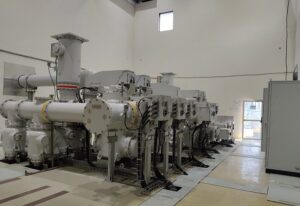

Broadly, AIS needs more land but is more cost-effective and easier to maintain, while GIS is compact and better suited to space-constrained or environmentally-exposed sites, at a higher capital and specialised-skill cost. We’ve built capability across both. Looking ahead, we expect GIS demand to keep rising, not just in urban or hilly locations but more broadly, as utilities increasingly value its lower long-term maintenance and environmental exposure and we’re investing accordingly in GIS-specific skills and equipment to stay ahead of that shift.
In the power distribution space, we understand that Vikran Engineering has executed several distribution infrastructure upgrade projects under RDSS. Tell us about recent achievements.
RDSS has become a steady and growing part of our distribution portfolio, spanning feeder segregation, substation augmentation and loss-reduction work across several states. Going forward, we expect RDSS-linked opportunities to keep expanding as discoms continue their loss-reduction and infrastructure-strengthening push, and we intend to keep scaling our distribution vertical in step with that it’s an area where we see steady, recurring order inflow over the next few years rather than one-off project wins.
“We already have a foothold in smart metering as part of our RDSS distribution scope, and evolving into a full AMISP is a direction we’re evaluating seriously.”
Going forward, do you envisage Vikran Engineering also turning towards smart metering under RDSS, which is to say evolving as an AMISP?
Yes, we already have a foothold in smart metering as part of our RDSS distribution scope, and evolving into a full AMISP is a direction we’re evaluating seriously. It fits well with our broader strategy of building annuity-style, recurring revenue streams alongside project-based EPC income. As more state utilities roll out AMISP tenders, we expect to make concrete moves in this direction, potentially owning the metering and billing-data layer on a service-fee basis over multi-year contract tenures rather than purely a supply-and-install role.
What are your views on supply chain management difficulties, for instance with respect to timely availability of EHV transformers? In the same vein, what challenges do you face with respect to availability of skilled manpower or “gangs” as they are called, for transmission line erection and stringing?
Both transformer availability and skilled-gang availability are likely to stay tight for a while, given how sharply substation and transmission capex is accelerating industry-wide. Our response, going forward, is to keep diversifying and deepening our vendor base, place orders further ahead of schedule, and invest more in structured in-house training so we’re building our own pipeline of skilled manpower rather than depending solely on the market. We see this as an ongoing capacity-building exercise rather than a problem with a fixed end date, it needs continuous investment as our own project pipeline grows.

How has technology contributed towards faster, safer and more scientific project execution, particularly with respect to transmission lines?
Technology is increasingly central to how we plan to execute, not just a support function. We’re continuing to expand digital systems for safety and permit management, and investing in structured, demonstration-based training to cut down on rework. Looking ahead, we expect broader industry trends — plug-and-play modular substations, wider GIS adoption, and dynamic line rating — to get more out of existing corridors to reshape how transmission projects are executed over the next several years, and we intend to be an early adopter of these rather than a follower.
We presume that much of Vikran Engineering’s orders are from government utilities (both Central and state). With private sector marking a growing presence in the power transmission space, thanks to the TBCB modality, do you see this ownership making a bigger contribution to your company’s order book?
That’s true of our book today, but we do expect the mix to shift. TBCB is now the default award route for the inter-state transmission system (ISTS), and private developers are taking a growing share of that pipeline industry-wide.
Our own move into an independent power producer role gives us useful exposure to how private developers think about cost and schedule certainty, which we believe positions us well to compete for TBCB-awarded private packages. Over the next few years, we’d expect the private/TBCB share of our order book to grow meaningfully, even as our core government-utility relationships remain central to the business.
“The outlook for our sector is about as strong as it’s been in years, with a multi-year, multi-trillion-rupee investment cycle underway in transmission, substations and distribution.”
In general, how do you see the road ahead for Vikran Engineering given the massive investment planned in India’s power T&D sector? What are the key milestones that you would like to see Vikran cross in the next, say, five years?
The outlook for our sector is about as strong as it’s been in years, with a multi-year, multi-trillion-rupee investment cycle underway in transmission, substations and distribution. For Vikran, having recently listed and strengthened our balance sheet, we’re focused on translating that macro opportunity into scale.
Over the next five years, our priorities are: moving up the voltage curve into 765kV transmission line execution, not just substations; building a materially larger share of private-sector/TBCB work into our order book; scaling our smart-metering and AMISP capability into a genuine recurring-revenue business; deepening our independent power producer platform as an annuity income stream alongside EPC; and continuing to diversify across water infrastructure and railway electrification so we remain a broad-based infrastructure player rather than a single-vertical contractor.
In summary, we want to keep growing in step with and ideally ahead of the pace of India’s power T&D investment cycle.