

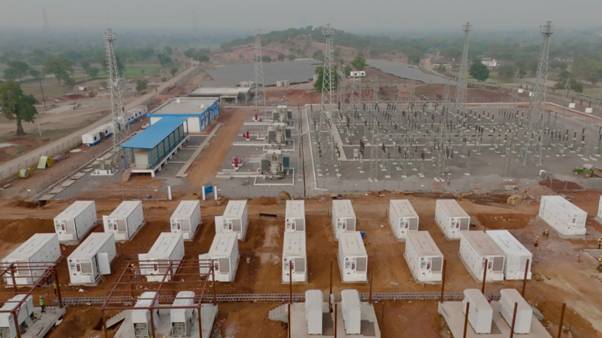
Tamil Nadu Electricity Regulatory Commission (TNERC) has permitted state utility Tamil Nadu Transmission Corporation Ltd (TANTRANSCO) to lease substation land to developers of upcoming battery energy storage system (BESS) projects in the southern state, at nominal rates.
In its order of August 28, 2025, TNERC has allowed the petition filed by TANTRANSCO seeking leasing of substation land at the rate of Re.1 per year for a period of 15 years. This land would be leased to developers of BESS projects in the state, and the developers would be given the “Right of Use” with respect to such land.
Tamil Nadu has been assigned 500 MW/1,000 MWh of BESS capacity under state viability gap funding (VGF) through Tamil Nadu Green Energy Corporation Ltd (TNGECL). [See table]
 The TNERC order states that the assets of TANTRANSCO that would be utilized for development of BESS projects is only the surplus land which is not otherwise required for undertaking licensed transmission activities and accordingly the activities of the transmission will not be affected.
At the same time the establishment of the BESS near the substation of TANTRANSCO will be in accordance with the policy decision of the Central Government and further will be in greater public interest of charging of the BESS and drawing of electricity from BESS projects at the time of need.
The order further states that the substation land to be utilized for development of BESS Projects shall not be sold, transferred, or otherwise used for any other purpose. These lands can only be used in a restrictive manner on right to use basis and that too under the supervision and control of TANTRANSCO.
VGF scheme: A background
To support India’s BESS initiatives, a viability gap funding (VGF) scheme was approved in September 2023. This scheme, with a budgetary allocation of Rs.3,760 crore, initially aimed at supporting 4 GWh of BESS capacity by FY31. [The 1,000 MWh BESS projects in Tamil Nadu discussed in this story fall under this category.]
It may be noted that falling battery prices, the target capacity under the above VGF scheme was substantially revised to 13.22 GWh whilst keeping the budgetary allocation unchanged. The assistance under this VGF scheme was originally pegged at Rs.96 lakh per MWh. This was later revised to Rs.48 lakh per MWh (in view of falling battery prices) or 30 per cent of the capital cost, whichever is lower. This revision took place in around March 2025.
A second VGF scheme was approved by the Union power ministry in June 2025 to develop 30 GWh of BESS capacity, with financial support of Rs.5,400 crore coming from the Power Sector Development Fund (PSDF).
Of the 30 GWh envisaged in the second VGF scheme, 25 GWh has been distributed across 15 states led by Rajasthan, Gujarat and Mahrashtra (getting 4 GWh each) while NTPC has been assigned 5 GWh. The VGF assistance has been fixed at Rs.18 lakh per MWh.
Featured photograph is for representation only