

India’s power transmission network of 220kV or above crossed the 5-lakh ckm mark recently.
A government release noted that this feat was achieved on January 14, 2026 when the 765kV Bhadla-II to Sikar-II line in Rajasthan, spanning 628 ckm, was commissioned.
With the commissioning of this line, the India’s National Grid – known to be the world’s largest synchronous grid – crossed a significant milestone, the release noted.
“The milestone of 5,00,000 ckm of transmission lines reflects the government’s sustained efforts towards ensuring reliable, affordable, and secure electricity supply across the country while supporting rapid growth in renewable energy integration,” the release said.
The country’s grid currently has a transformation capacity of 1,407 GVA, considering substations of 220kV or above.
Growth since 2014
Since April 2014, the country’s transmission network has grown by 71.6 per cent with the addition of 2.09 lakh ckm of transmission lines (220kV and above), boosting transformation capacity (220kV and above) by 876 GVA. [1 GVA = 1,000 MVA]
The interregional power transfer capacity, which now stands at 1,20,340 MW, has enabled seamless transfer of electricity across regions, successfully realizing the vision of “One Nation – One Grid – One Frequency,” the release noted.
Recent growth trends
As can be seen from the table below, transmission line addition during FY25 fell sharply to 8,830 ckm, succumbing largely to R0W-related challenges. This made an adverse comparison with the preceding four-year period from FY20 to FY24 when 14,427 ckm was added on average. During the first nine months of current fiscal year FY26, transmission line addition stood at 5,077 ckm. While the planned addition in FY26 stands at 10,696 ckm, it appears that FY26 will close with under-achievement.
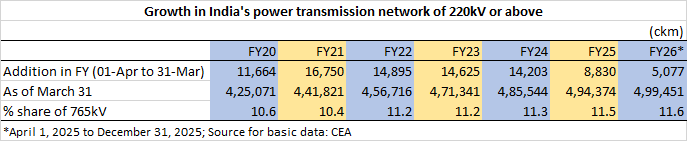
During the five period from FY20 to FY25, India’s transmission network (of 220kV or above) showed a compounded annual growth rate (CAGR) of around 3.1 per cent. On the other hand, 765kV lines did better with a corresponding CAGR of 4.9 per cent. This is also borne out in the share of 765kV line in India’s total transmission network (of 220kV or above) rising from 10.6 per cent in FY20 to 11.5 per cent in FY25.
Projects under implementation
Interstate transmission system (ISTS) projects, currently under implementation, are expected to add around 40,000 ckm of transmission lines and 399 GVA of transformation capacity. In addition, intrastate transmission system (InSTS) projects under implementation are expected to add another 27,500 ckm of transmission lines and 134 GVA of transformation capacity, which will further enhance grid reliability and power evacuation capability.
Bhadla-II to Sikar-II line
According information available with tndindia.com, the Bhadla-II – Sikar-II line that completed the final leg of the 5-lakh ckm journey, is part of an interstate-TBCB project of Power Grid Corporation of India Ltd (PGCIL).
Officially termed as “Transmission system strengthening scheme for evacuation of power from solar energy zones in Rajasthan (8.1 GW) under Phase-II, Part E,” this project is housed under PGCIL’s TBCB subsidiary “Powergrid Bhadla Sikar Transmission Ltd.”
The commissioning of this line – the lone element of the project – rendered the project fully commissioned, making it PGCIL’s eight ISTS-TBCB to fully commission in FY26 so far. For more details, please refer to tndindia.com story dated January 19, 2026.
Also read: India’s power generation capacity crosses 5-GW mark, non-fossil fuels wield dominant share
Featured photograph (source: PGCIL) is for representation only