

Transformation capacity addition on ISTS exceeds that of intrastate network in FY26
- February 26, 2026
The first ten-month period (April to January) of the ongoing fiscal year FY26 has seen more transformation capacity getting commissioned on the interstate transmission system (ISTS) than on its intrastate (InSTS) counterpart, official statistics suggest.
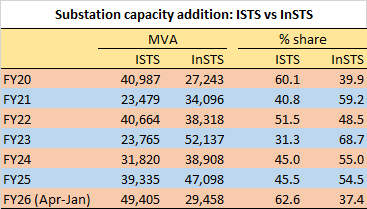
According to latest statistics released by Central Electricity Authority (CEA), a total of 49,405 MVA of transformation capacity was commissioned on the ISTS side, much higher than the InSTS addition of 29,458 MVA, during the first ten months (10M: April to January) of FY26.
Put differently, of the total 78,863 MVA commissioned during 10MFY26, nearly 63 per cent was on the ISTS network as compared with 37 per cent on the intrastate grid.
Over the past three years – FY23 to FY25 – more substation capacity has been added on the intrastate grid (see table). This year’s phenomenon therefore marks a reversal of trend.
One major reason for this phenomenon is that a significant volume of transformation capacity that was to come onstream during FY24 and FY25 got pushed to FY26, resulting in an unusual “lumping” of capacity addition this fiscal year. This has been especially true of several key projects of Power Grid Corporation of India Ltd (PGCIL).
 During 10MFY26, PGCIL commissioned 41,005 MVA of transformation capacity that was more than twice the comparable 20,015 MVA in the first ten months of FY25. In fact, of the total 78,863 MVA commissioned in the April-January period of FY26, PGCIL alone accounted for 52 per cent. Since PGCIL’s infrastructure creation is predominantly on the ISTS network, the share of ISTS in overall substation capacity addition was bolstered in FY26. It may be noted that PGCIL also operates in the intrastate space, mainly through TBCB projects, but this forms a minuscule share in the overall scheme of things.
The private sector also contributed in fair measure to transformation capacity augmentation on the ISTS side, thanks to commissioning of substation elements of interstate-TBCB projects like those of Apraava Energy, Megha Engineering, Adani Energy Solutions and Resonia, among others.
Incidentally, the 78,863 MVA of substation capacity added in the April-January period of FY26 was 53.1 per cent higher than the corresponding 51,500 MVA in FY25, though it could meet only 72.3 per cent of the targeted 1,09,127 MVA.
For the full year FY26 (April to March), the targeted substation capacity addition is 1,26,007 MVA. If achieved in full, it would represent a 46 per cent growth over the 86,433 MVA actually commissioned in FY25 (full year).
Again, in FY26 (full year), PGCIL has planned to commission 62,005 MVA, which will be entirely on the ISTS side. Besides, private sector entities are likely to commission around 8,000 MVA on the ISTS network during February and March 2026. This will be addition to an estimated 8,500 MVA achieved in the April-January period of FY26.
With this, one can expect ISTS addition to surpass the InSTS achievement by a significant margin, during FY26.
Cumulative status
As of January 31, 2026, India’s total transformation capacity (of 220kV or higher) stood at 1,416,376 MVA (or roughly 1,416 GVA). Of this, 42.7 per cent (or 605 GVA) was on the ISTS network with InSTS wielding the majority share of 57.3 per cent.
The share of ISTS in India’s total transformation capacity is projected to reach around 50 per cent by end of FY27, according to the latest National Electricity Plan – Transmission. By then, India’s total transformation capacity would have reached 1,882 GVA.
Also read: Transformation capacity addition: Good start to FY26
Note: This story relates to substations of 220kV or higher only; 1 GVA = 1,000 MVA. Featured photograph is for representation only