

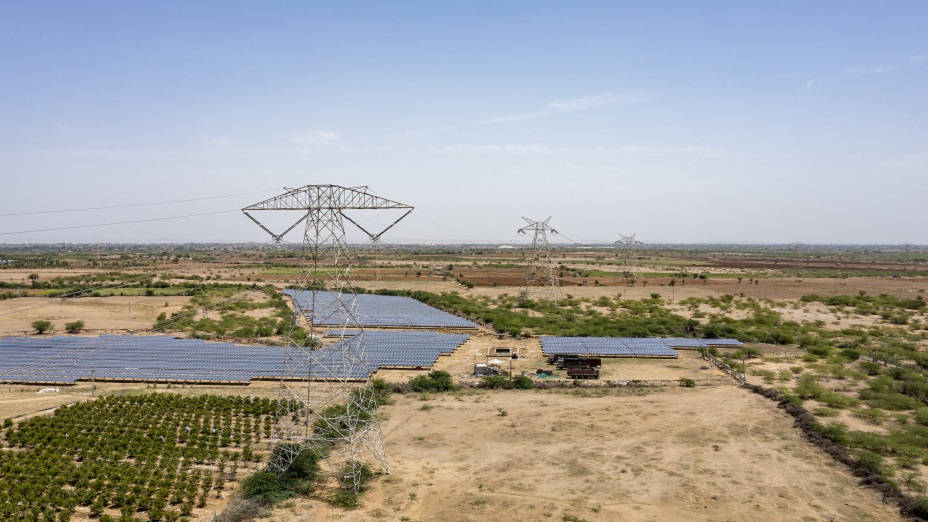
Integration of around 26 GW of renewable energy (RE) capacity has been achieved so far under the Green Energy Corridor (GEC) project, it was informed in Parliament.
According to a written reply given in the Rajya Sabha, Shripad Naik, Minister of State for Power, integration of 26 GW of RE capacity has been achieved under the two phases of the Green Energy Corridor project – GEC-I and GEC-II.
It was also informed that GEC-III, comprising InSTS schemes for large-scale RE integration, was under consideration.
GEC, through its two phases, aims at integration of a total of 44 GW of RE capacity. Being implemented by the Ministry of New & Renewable Energy (MNRE), GEC is a cluster of several intrastate transmission system (InSTS) schemes spread over ten RE-rich states – Rajasthan, Karnataka, Andhra Pradesh, Himachal Pradesh, Madhya Pradesh, Kerala, Gujarat, Uttar Pradesh, Maharashtra and Tamil Nadu.
While 26 GW has been integrated so far, projects corresponding to the remaining 18 GW are currently under implementation.
Meanwhile, as part of the interstate transmission system (ISTS) augmentation, schemes aiming at integrating around 207 GW of solar and wind capacity are currently under implementation, it was informed.
Energy storage
To address the intermittency associated with RE sources, the government is promoting a combination of energy storage and hybrid solutions to ensure grid stability and reliable power supply. To this effect, transmission system for 35.6 GW of pumped storage projects (PSP) and around 47 GW of battery energy storage system (BESS) has been planned to be commissioned by end of FY32 (March 2032).
Overall objective
The national objective is to integrate 500 GW of non-fossil fuel capacity by 2030, moving further to 600 GW by 2032. This would be achieved through ISTS schemes as well as InSTS schemes envisaged under GEC-I and GEC-II. Non-fossil fuel capacity comprises RE sources as well as non-thermal conventional sources like hydropower and nuclear power.
Under the National Electricity Plan, India’s power transmission infrastructure (of 220kV or above) by March 2032, is projected to expand to 6.48 lakh ckm of transmission lines and 2,345 GVA of transformation capacity. Besides, interregional transfer capacity is seen increasing to 168 GW by 2032.
According to latest statistics released by Central Electricity Authority, India power transmission infrastructure (of 220kV or above), as of February 28, 2026, stood at: 5.04 lakh km (transmission lines), 1,429 MVA (transformation capacity) and 120 GW (interregional transfer capacity).
Featured photograph (source: Adani Energy Solutions Ltd) is for representation only