

The Indian government is supporting the manufacturing and deployment of battery energy storage systems (BESS) with favourable regulations. New rules, subsidies, and incentives are encouraging more investment into battery storage which helps bring the costs down and speeds up its adoption, notes Abhinandan Sethi.

India is moving towards clean energy future at remarkable scale to achieve the ambitious target of reaching 500 GW of non-fossil fuel-based energy capacity by the end of this decade. The country’s green energy plan is focused on reaching net-zero emissions by 2070, a commitment made at the COP26 Summit. India is also part of the Paris Agreement, which works to keep global temperature rise below 2°C.
In FY25, India added 29.52 GW of new renewable energy capacity. By the end of September 2025, India’s total installed energy capacity reached 500.89 GW, with 256.09 GW (51 per cent) coming from non-fossil sources, while remaining 244.80 GW (49 per cent) from fossil fuel-based sources. As the clean energy sources are not always available, they make it harder to keep the power grid stable. To address these challenges, India is emphasizing on energy storage to handle variability in renewable generation. The Ministry of Power has mandated that all renewable energy implementing agencies and state utilities must incorporate a minimum of two-hour co-located energy storage systems (ESS), equivalent to 10 per cent of the installed solar project capacity, in future solar tenders.
This move signals that India is serious about not just adding renewable energy (RE) capacity but also making that RE usable & reliable. Storage-backed renewables help reduce wasted generation and enable better utilization of energy. It supports the push toward a cleaner, more flexible grid, critical for India’s 500 GW non-fossil target and long-term net-zero goals.
India’s ambitious goal to build 500 GW of non-fossil energy capacity by 2030 will not only accelerate its clean-energy transition but also drive a massive demand for grid-scale storage, helping the country build a resilient, low-carbon power system for the future.
Role of BESS
The market for battery energy storage system (BESS) is growing rapidly. According to a Globe Newswire report, the BESS market grew from $56.29 billion in 2024 to estimated $68.70 billion in 2025. It is expected to continue growing at a CAGR of 22.13 per cent, reaching $186.90 billion by 2030.In India, the BESS capacity could reach 208 GWh and market value could reach $32 billion by that time, and by 2047, when we celebrate the nation’s centenary of independence, it might grow to 1840 GWh of storage with a total market value of $443.4 billion.
 The energy storage landscape is evolving rapidly because of big leaps in technology and push for adding significant renewable energy and storage capacity in India. New solar projects are being announced with battery-storage systems, and they are certainly transforming how energy is generated and used.
New types of batteries are being introduced apart from the usual lithium-ion. There are solid-state batteries, sodium-ion batteries, and even systems based on gravity and hydrogen. These new technologies make storage safer, stronger, and more efficient. Smart technologies like AI and IoT are getting deeply integrated with storage systems, playing a major role in its advancement. Artificial intelligence is used to watch over batteries, predict when a battery might fail, and make systems run more smoothly. Sensors and the Internet of Things connect everything, optimize how charge and discharge happens and make the whole setup more reliable.
The Indian government is supporting the manufacturing and deployment of BESS with favourable regulations. New rules, subsidies, and incentives are encouraging more investment into battery storage which helps bring the costs down and speeds up its adoption.
A practical and scalable solution
Power utilities are increasingly relying on BESS for medium-term storage, typically offering four to eight hours of discharge. Long-duration battery technologies that can store energy for days are still under early stage of research and it is supposed to be more expensive. But they are gaining attention for their potential to provide reliability during extended outages or periods of low energy generation.
The new-age storage batteries are cost-effective when paired with solar power and can support the grid with reliable backup supplies. The battery energy storage systems are commonly built to discharge for 1 to 4 hours, but in some cases, they can be designed for longer durations, like 6 to 10 hours depending on the usage. How long the battery is meant to run depends on what it is meant to do, shorter-duration systems are great for applications like frequency regulation, while longer-duration storage are more suited to tasks like peak demand shaving or storing large amounts of energy. For now, BESS offers a practical, scalable solution to help balance intermittency, support peak demand, and improve overall grid stability.
With the global clean-energy transition and growing deployment of storage systems, BESS is projected to expand at more than 22 per cent annually, reaching a market size of $186.90 billion by 2030.
Contributing to India’s BESS ambitions
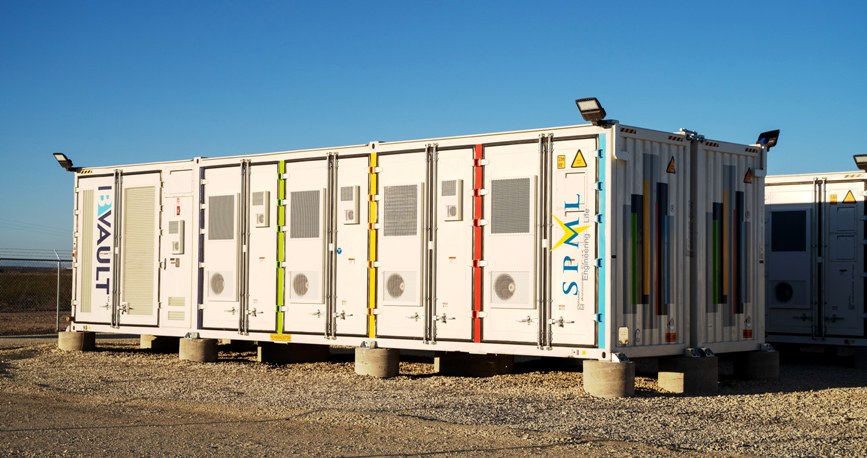 SPML Infra has entered a 10-year exclusive partnership with Energy Vault, a US-based leader in sustainable energy storage. Through this, SPML Infra will locally manufacture the B-VAULT battery systems and deploy the VaultOS digital energy management platform in India. This partnership is significant as it gives us a strong technological edge, combining our infrastructure development expertise with world-class technology-enabled storage solutions.
Our BESS effort is moving forward strongly and remains on track. We are setting up one of India’s first fully integrated BESS manufacturing and integration plants in Pune. Phase-1 is already under development with plant construction is underway. In the first phase, we plan to produce 2.5 GWh of storage capacity.
In Phase-2, we aim to scale up the capacity to 5 GWh by FY28. We have plans to localize our manufacturing abilities and expect to significantly cut costs, rely less on imports, and execute more projects with better returns.
This BESS initiative aligns directly with India’s goal of building 500 GW of non-fossil energy and substantial storage capacities over the next five years. By empowering clean energy storage, SPML Infra is strengthening its role in the renewable value chain and potentially opening the door to exports in the future. With a deep technology tie-up, disciplined project execution, and a clear focus on innovation, our BESS business is poised to become a major growth engine for India’s BESS sector.
Way forward
The increasing push to pair BESS with renewable energy, especially solar and wind, creates significant opportunities. By storing surplus energy generated during peak periods, BESS enhances the reliability, consistency, and efficiency of renewables, supporting the shift toward a decarbonized energy grid. There is a $42-billion (Rs.3.5-trillion) potential investment opportunity in BESS ecosystem by FY32.
From 2025 to 2032, the energy storage segment is forecasted to be the fastest growing sector, driven by the global push for renewable energy integration and grid modernization. With more emphasis on grid resilience, climate-driven disruptions, renewable energy integration, and the need for uninterrupted power supply, energy storage remains a top priority for utilities and large industries. BESS is rapidly emerging not only as a technology of choice but as a transformational enabler for a cleaner, more flexible, and future-ready power system. By expanding battery storage across the country, India can meet its climate goals while building a power system that is both steady and environmentally responsible. SPML Infra Ltd is fully committed to this vision. We are working diligently to scale up our BESS business, contribute to India’s clean energy transformation, and become a key partner of the country’s green power future to achieve the national vision of ‘Viksit Bharat’.
About the author: Abhinandan Sethi is Managing Director, SPML Infra Ltd