

India’s power generation capacity crosses 5-GW mark, non-fossil fuels wield dominant share
- December 2, 2025
India’s total power generation capacity has crossed the 5-GW mark, it was informed in Parliament recently. Moreover, the share of non-fossil fuel capacity has surpassed that of fossil-based fuels.
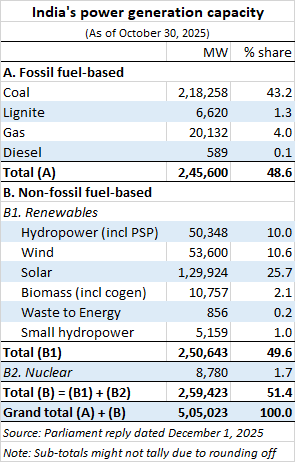
A government release based on a written reply by Minister of State for Power Shripad Yesso Naik in the Rajya Sabha on December 1, 2025, noted that India’s total power generation capacity stood at 5,05,023 MW, as of October 31, 2025.
This included 2,45,600 MW from fossil-based fuels and 2,59,423 MW from non-fossil fuels (renewables and nuclear). Thus, the share of non-fossil fuel-based capacity, at 51.4 per cent has outpaced the 48.6 per cent held by fossil fuel-based power generation capacity.
Power generation capacity from renewable energy alone (excluding nuclear) had a share of 49.6 per cent, still higher than that of fossil fuel-based capacity.
Accelerating RE capacity
The release also noted that the Union Government has taken several steps and initiatives to promote and accelerate renewable energy capacity in the country to realize the commitment of 500 GW non-fossil energy capacity by 2030.
These include, inter-alia, the following:
- Interstate transmission system (ISTS) charges have been waived for inter-state sale of solar and wind power for projects to be commissioned by 30th June 2025, for Green Hydrogen Projects till December 2030 and for offshore wind projects till December 2032.
 Standard Bidding Guidelines for tariff based competitive bidding process for procurement of Power from Grid Connected Solar, Wind, Wind-Solar Hybrid and Firm & Dispatchable RE (FDRE) projects have been issued.
- Ministry of New & Renewable Energy (MNRE) has issued Bidding Trajectory for issuance of RE power procurement bids of 50 GW/annum by Renewable Energy Implementing Agencies (REIAs) from FY24 to FY28.
- Foreign Direct Investment (FDI) has been permitted up to 100 percent under the automatic route.
- Laying of new transmission lines and creating new substation capacity has been funded under the Green Energy Corridor Scheme for evacuation of renewable power
- To augment transmission infrastructure needed for steep RE trajectory, transmission plan has been prepared till 2032.
- Scheme for setting up of Solar Parks and Ultra Mega Solar Power projects is being implemented to provide land and transmission to RE developers for installation of RE projects at large scale
- Schemes such as Pradhan Mantri Kisan Urja Suraksha evam Utthaan Mahabhiyan (PM-KUSUM), PM Surya Ghar Muft Bijli Yojana, National Programme on High Efficiency Solar PV Modules, New Solar Power Scheme (for Tribal and PVTG Habitations/Villages) under Pradhan Mantri Janjati Adivasi Nyaya Maha Abhiyan (PM JANMAN) and Dharti Aabha Janjatiya Gram Utkarsh Abhiyan (DA JGUA), National Green Hydrogen Mission, Viability Gap Funding (VGF) Scheme for Offshore Wind Energy Projects have been launched
- To boost RE consumption, Renewable Purchase Obligation (RPO) followed by Renewable Consumption Obligation (RCO) trajectory has been notified till 2029-30. The RCO which is applicable to all designated consumers under the Energy Conservation Act 2001 will attract penalties on non-compliance. RCO also includes specified quantum of consumption from Decentralized Renewable Energy sources.
- “Strategy for Establishments of Offshore Wind Energy Projects” has been issued.
- Green Term Ahead Market (GTAM) has been launched to facilitate sale of Renewable Energy Power through exchanges.
- To achieve the objective of increased domestic production of Solar PV Modules, the Government of India is implementing the Production Linked Incentive (PLI) scheme for High Efficiency Solar PV Modules. This will enable manufacturing capacity of GW-scale in high efficiency solar PV modules.
The impact of this achievement on India’s long term energy transition roadmap is crucial towards the goal of combating climate change, keeping in view energy security, affordability and accessibility as critical inalienable priorities to ensure growth and development alongside Energy transition of the economy towards net-zero by 2070, the release said.
Also read: India’s power generation capacity estimated at 817 GW by FY30
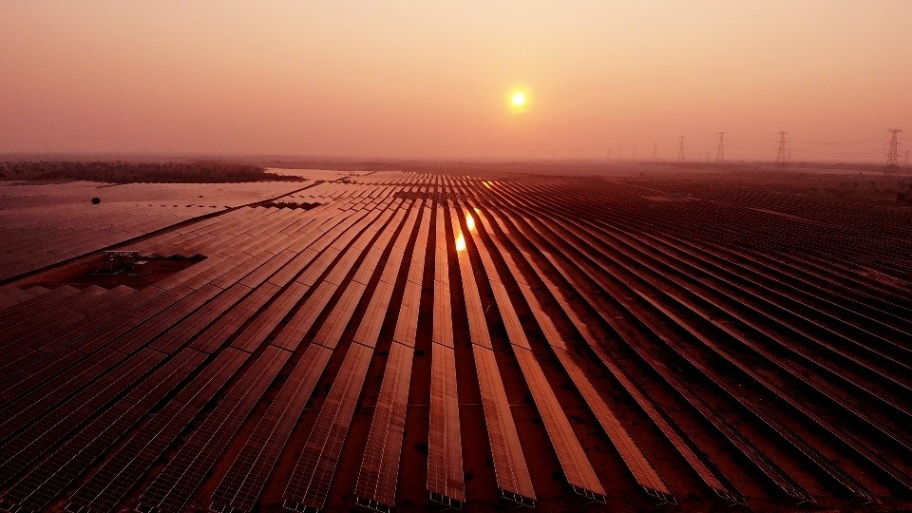
Featured photograph (source: Avaada Group) is for representation only