

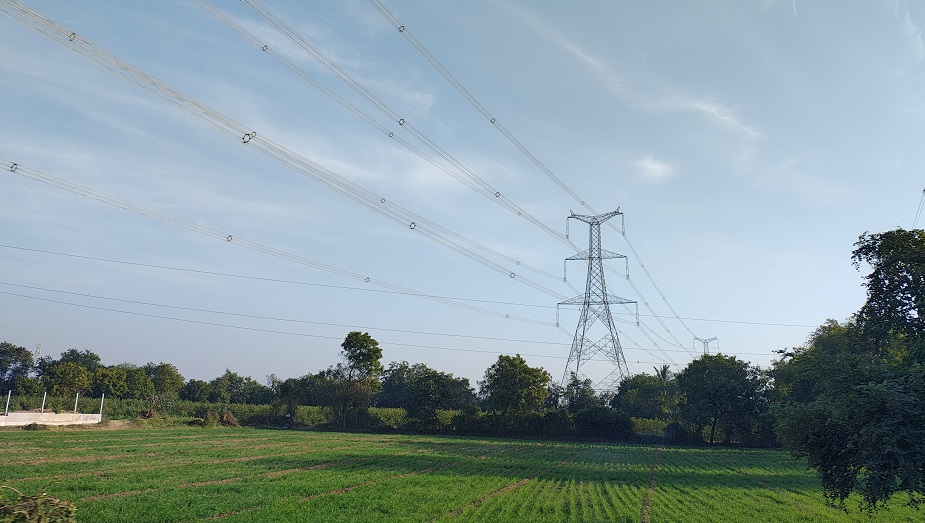
Interstate transmission system (ISTS) schemes for evacuation of 25.8 GW of renewable energy were approved during the January-November period of 2025, a government release said.
These projects entail estimated investment of Rs.38,849 crore. The release, outlining the country’s achievements in the power sector during 2025, said that transmission network with capacity 335 GW would be needed to connect 280 GW of variable renewable energy to the ISTS network by 2030.
Of this, 48 GW has already been completed while another 172 GW is under construction. Schemes worth 18.5 GW are under bidding while the remaining 96.5 GW will be approved in due course.
Here are some more highlights of the annual review
- During 2025 (January to December), 6,511 ckm of transmission lines (of 220kV or above), 1,00,368 MVA of transformation capacity (of 220kV or above) and 1,600 MW of interregional transfer capacity have been added.
- The power ministry, in March 2025, issued supplementary guidelines for payment of compensation in regard to right-of-way (RoW). These supplementary guidelines provide for assessment of market rate of land, to be determined by a Market Rate Committee (MRC) based on the valuation by independent land valuers, for the payment of RoW compensation. The compensation amount for RoW corridor has been revised for ISTS lines as 30 per cent of the land value in rural areas, 60 per cent of the land value in municipal corporations and metropolitan areas notified by the state government, and 45 per cent of the land value for municipalities, nagar panchayats and all other urban planning areas notified by the state government.
- It may be recalled that in June 2024, the power ministry revised RoW guidelines, linking compensation to the market value of land. For tower base area, the compensation was increased from 85 per cent to 200 per cent of the land value. For the RoW Corridor, compensation has been raised from 15 per cent to 30 per cent of the land value.
- As of December 31, 2025, 3.76 crore consumer meters, 12.56 lakh distribution transformer (DT) meters and 1.58 lakh feeder meters have been installed under the Revamped Distribution Sector Scheme (RDSS).
- AT&C losses have come down to 16.16 per cent (provisional) in FY25 from 21.91 per cent in FY21. Similarly, the ACS-ARR gap reduced to Rs.0.11 per kWh from Rs.0.69 per kWh, by the same comparison.
- Under Viability Gap Funding (VGF) scheme, 43220 MWh of battery energy storage system (BESS) is targeted for addition.
- As envisaged in the latest National Electricity Plan (2023 to 2032), India transmission network of 220kV or higher will be expanded from 4.98 lakh ckm in November 2025 to 6.48 lakh ckm in 2032. During the same period transformation capacity will increase from 1,398 GVA to 2,345 GVA. Interregional transfer capacity will increase from 120 GW to 168 GW, by the same comparison.
- Energy shortages at the national level have reduced to a mere 0.03 per cent in FY26, a major improvement from 4.2 per cent in FY14.
- Per capita electricity consumption in India rose to to 1,460 kWh in FY25, marking a 52.6 per cent increase from 957 kWh in FY14.
- The average availability of electricity in rural areas has increased from 12.5 hours in 2014 to 22.6 hours in 2025, while urban areas now enjoy up to 23.4 hours of power supply as compared to 22.1 hours in 2014.
Also read: ISTS-TBCB market in 9MFY26: 12 schemes, 7 winners, Adani Energy enjoys highest market share
Featured photograph is for representation only