

Creating a comprehensive charging infrastructure is necessary to promote the use of electric vehicles and decrease reliance on fossil fuels, delivering environmental sustainability. A major part of this journey will be determined by robust public-private partnerships between government, industry, and academia, observes Rajesh Kaushal.

The electric vehicle (EV) market in India is witnessing an incredible pace of growth and is expected to reach a 30–40 per cent EV adoption rate by 2030. This growth is driven by ambitious state targets like Maharashtra’s target to achieve a 10 per cent EV registration share by 2025 and Karnataka’s ambition to make all three- and four-wheeler cargo vehicles electric by 2030. Consequently, the development of EV infrastructure in India is gaining significant momentum.
At the heart of this will be the rollout of an extensive, localized charging infrastructure. As of now, India has 12,000 public charging stations, and going forward, it intends to install over 400,000 annually. To further accelerate this progress, localizing production of EV chargers has emerged as a strategic necessity—cutting costs, complying with policy mandates, and diversifying supply chain risk.
Policy Push & Government Support
The Indian government has been making moves to actively foster domestic EV manufacturing, including under the Make in India program and the Production Linked Incentive (PLI) scheme. For instance, in April 2024, the Electric Mobility Promotion Scheme was launched with a Rs.500-crore budget, which was expected to support about 3.7 lakh electric two- and three-wheeler vehicles.
This initiative is also influencing state governments, leading to policies that either mandate or encourage local sourcing and manufacturing. This, in turn, fosters a strong and independent supply chain. For instance, another example of this will be the NITI Aayog’s plan to achieve a 30 per cent uptake in electric vehicles by 2030 with the aim to rake in 80 per cent market share in two- and three-wheeler segments. The establishment of this strong framework will also contribute to India’s objectives of reaching net-zero emissions, enhancing energy security by reducing reliance on fossil fuels, and promoting sustainable mobility.
Benefits of Localizing EV Charger Manufacturing
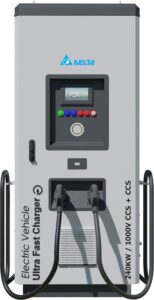 Local manufacturing of EV chargers offers several key advantages. It significantly reduces reliance on imports, lowers logistics costs, and improves overall quality control. This approach also reduces supply chain risks, allowing for faster and more efficient deployment of charging infrastructure.
This is also expected to boost products designed for the Indian climate, usage patterns, and grid condition, which will improve the experience of the customers.
Domestic production also provides massive employment opportunities, such as in the fields of engineering, assembling, and supply chains, thus leading to the growth of local communities. In general, localization of engineering work creates a fertile ecosystem for innovation with the power to speed EV uptake, increase energy security, and complement India’s broader sustainability agenda.
Building a Local EV Supply Chain Ecosystem
It is important to have an exclusive supply chain ecosystem to cater to its EV aspirations in India. Getting important parts like power modules, circuit boards, software, and casings from local suppliers can help us get things done faster, save money, and improve quality. Creating specialized production lines for critical components, such as charging guns and connectors, also makes for greater dependability and efficiency. Partnering with smaller businesses (MSMEs) and top universities like IITs, IIITs, and IISc is a smart move. It helps boost innovation, develop new technologies, and also expand manufacturing capabilities. Vertical integration and strategic partnerships with Indian automakers and fleet operators are poised to significantly enhance operational efficiency. Original Equipment Manufacturers (OEMs) collaborating with fleet operators—whether for shared asset management, comprehensive fleet oversight, or advanced telematics services—can further improve their overall performance.
Challenges to Overcome
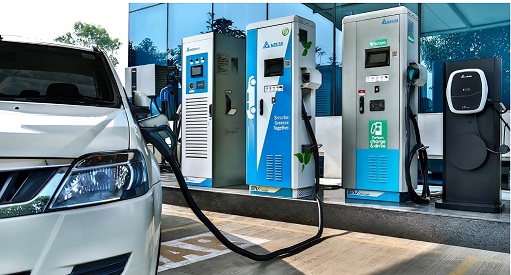
The outlook is promising, but not without significant challenges holding India back from having a large EV charging infrastructure of its own. Building a workforce capable of doing this is a big challenge; SIAM estimates that India requires about 1 to 2 lakh trained professionals by 2030 to back the 30 per cent electric penetration. High-power charging up to 180kW – 350kW is another technical challenge. It is costly, dangerous for battery degradation, and difficult for drivers to access because of the incompatibility with several models of EVs.
Moreover, standardization and certification processes—particularly aligning BIS standards with AC/DC protocols—are complex but essential for safety, interoperability, and scalability. Addressing these technological and regulatory hurdles is crucial in establishing a reliable, safe, and scalable EV charging network.
Role of R&D and Innovation
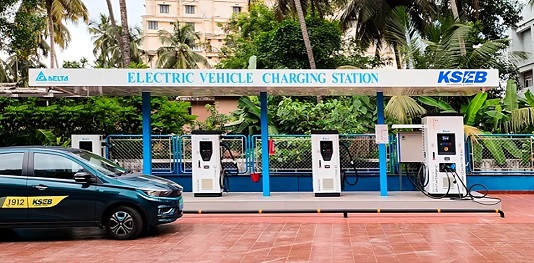
“Design in India” is critical for innovation, job creation, and global competitive competitiveness as part of “Make in India”. Smart communicating chargers (incorporating cloud, energy management, and load balancing) will minimize energy consumption, enable renewable energy integration, and improve user experience.
Ties with academic institutions such as IITs and IISc help speed up technology transfer. An example of this is IISc’s solar-powered EV charging stations. Companies such as Delta Electronics India show how industry-academia partnerships can assist in R&D—budgeting 6–7 per cent of revenue on innovation and creating over 100 charger models.
Conclusion
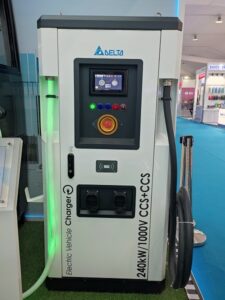 India can shift from importing EV chargers to becoming a top exporter. It can use its manufacturing skills to make a local, energy-rich EV charging network. This could make the country become a world leader in EV charging. Creating a comprehensive charging infrastructure is necessary to promote EV use and decrease reliance on fossil fuels, delivering environmental sustainability.
A major part of this journey will be determined by robust public-private partnerships between government, industry, and academia. These partnerships must be supported by a targeted policy as well as consistent investment in R&D and local manufacturing. Programs such as Make in India, PLI, and strategic partnerships with premier institutions will be crucial in bringing about this change. This is of huge importance to India. If these are coordinated, India can expedite the move towards sustainable mobility and create job opportunities to power its way towards becoming a global hub for EV infrastructure.
About the author: Rajesh Kaushal is Energy Infrastructure & Industrial Solutions (EIS) Business Group Head, India & SAARC, Delta Electronics India.