

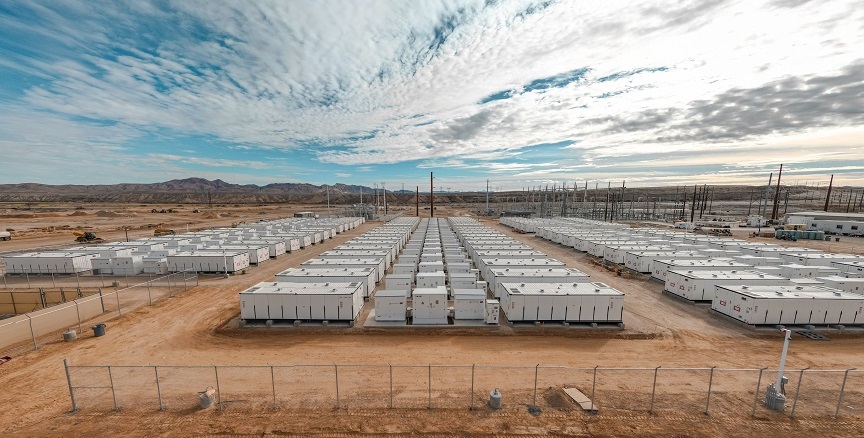
It was recently informed in Parliament that over 51 GWh of battery energy storage system (BESS) capacity is currently under construction or under bidding.
In a written reply tabled in the ongoing Lok Sabha session, Shripad Naik, Minister of State for Power said that 15,829 MW/51,106 MWh of BESS capacity is currently under construction or in bidding stage. [This is approximately 16 GW/51.11 GWh]
In reply to another question, the minister said Central Electricity Authority (CEA) has estimated that India would need BESS capacity of 41.6 GW/208 GWh by FY30. [1 GWh = 1,000 MWh]
Meanwhile, independently available official figures suggest that CEA has projected India’s long-term BESS demand to touch 236 GWh by FY32, with medium-term demand likely to be 37 GWh by FY27.
To support India’s BESS initiatives, a viability gap funding (VGF) scheme was approved in September 2023. This scheme, with a budgetary allocation of Rs.3,760 crore, initially aimed at supporting 4 GWh of BESS capacity by FY31.
With falling battery prices, the target capacity under the above VGF scheme was substantially revised to 13.22 GWh whilst keeping the budgetary allocation unchanged. The assistance under this VGF scheme was originally pegged at Rs.96 lakh per MWh. This was later revised to Rs.48 lakh per MWh (in view of falling battery prices) or 30 per cent of the capital cost, whichever is lower.
A second VGF scheme was approved by the Union power ministry in June 2025 to develop 30 GWh of BESS capacity, with financial support of Rs.5,400 crore coming from the Power Sector Development Fund (PSDF).
Of the 30 GWh envisaged in the second VGF scheme, 25 GWh has been distributed across 15 states led by Rajasthan, Gujarat and Mahrashtra (getting 4 GWh each) while NTPC has been assigned 5 GWh. The VGF assistance has been fixed at Rs.18 lakh per MWh.
BESS capacity addition
Meanwhile, according a report by Mercom, India added 341 MWh of BESS capacity in 2024 as against 51 MWh in 2023.
The country’s cumulative installed BESS capacity, as of December 2024, stood at 442 MWh, Mercom said. Of this, 60 per cent came from solar+BESS projects, 36 per cent from RE resources integrated with RTC (round-the-clock) capabilities. The remaining came largely from standalone BESS projects, the Mercom report said.
Featured photograph (source: SPML Infra Ltd) is for representation only