


Power Grid Corporation of India Ltd (PGCIL) has been a very big contributor to all-India new transformation capacity addition during FY26, government statistics suggest.
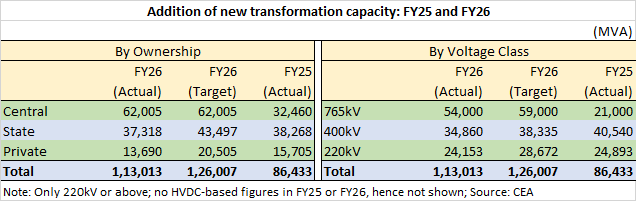
According to latest statistics released by Central Electricity Authority (CEA), PGCIL commissioned as much as 62,005 MVA (around 62 GVA) of new transformation capacity in FY26 (April 1, 2025 to March 31, 2026). This accounted for more than half of the overall national achievement, considering voltage classes of 220kV or above only.
Total transformation capacity addition in FY26 stood at 113,013 MVA with PGCIL alone accounting for 55 per cent.
It is also likely that PGCIL’s achievement in FY26, at 62,005 MVA, was its best-ever performance at least in recent history. In FY25, PGCIL had commissioned 31,515 MVA of transformation capacity. For FY24 and FY23, PGCIL’s figures are not separately available. However, the Central government ownership group commissioned 19,720 MVA and 36,195 MVA, respectively, in the two years. Even if one assumes that the entire contribution in these two years came from PGCIL alone, the Central PSU’s performance in FY26 makes it the best-ever in recent history. [Incidentally, Damodar Valley Corporation (DVC) is the only other Central PSU involved in transformation capacity of 220kV or higher. Further, PGCIL’s share the entire ownership group’s performance has traditionally been very dominant.]

Here are some more highlights:
- PGCIL’s achievement of 62,005 MVA in FY26 implied 100 per cent achievement of the planned addition.
- Of the total FY26 addition by PGCIL, over 44 per cent was achieved in Q4 (January to March) alone.
- India’s total substation capacity addition in FY26, at 113,013 MVA fell slightly short of the planned addition of 126,007 MVA but it was over 30 per cent higher than the FY25 level of 86,433 MVA
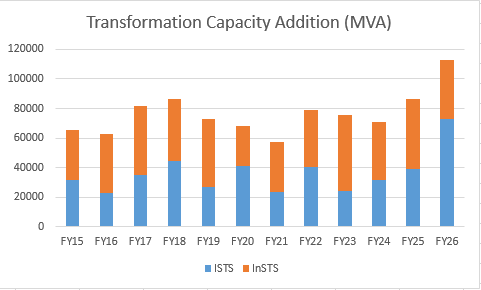
- The overall FY26 achievement, at 113,013 MVA, was the highest in any fiscal year ever.
- Both the state government and private sector ownership groups saw a year-on-year decline in their respective FY26 performance. Besides, both these groups also failed to achieve their planned addition. (See table)
- Nearly half (around 48 per cent) of the overall transformation capacity added in FY26 was at the 765kV voltage level. This boded well for the interstate transmission system (ISTS) grid. In physical terms, 54,000 MVA was added at the 765kV level in FY26, once again the highest such annual addition in recent times. Total substation capacity addition on the ISTS side was 72,905 MVA in FY26, representing a 65 per cent share in total.
- Though the private sector added only 13,690 MVA in FY26 — lower than the planned 20,505 MVA and 13 per cent lower than 15705 MVA in FY25 — a diversity of private transmission service providers (TSP) including Adani Energy Solutions, Torrent Power, Tata Power, Resonia, Megha Engineering, IndiGrid and ReNew Power, contributed.
- There was no addition of HVDC-based transfer capacity in FY26 as was the case in the past three fiscal years at least.

Cumulative Status
As of March 31, 2026, the country’s total transformation capacity (of 220kV or above) stood at 1450,526 MVA (or 1,450 GVA). Of this, the ISTS grid accounted for 43 per cent. In terms of voltage, the 400kV class had the highest share – at 37 per cent.
Also read: PGCIL drives country’s substation capacity addition in FY26
Featured photograph (source: MPPTCL) is for representation only