

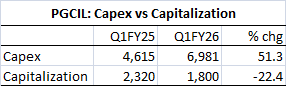
Power Grid Corporation of India Ltd (PGCIL) has recorded a year-on-year growth of over 50 per cent in capital expenditure (capex) during the first quarter (Q1: April to June) of FY26.
Addressing an investor conference recently, R.K. Tyagi, Chairman & Managing Director, PGCIL, said that the company’s capex during Q1FY26 was Rs.6,981 crore, up 51 per cent from Rs.4,615 crore in Q1FY25.
For FY26 as a whole, PGCIL expects to incur capital expenditure of Rs.28,000 crore, implying a growth of around 7 per cent from Rs.26,255 crore in FY25. It may be noted that PGCIL’s FY25 capex was its highest-ever in any fiscal year since FY18 at least.
Around 68 per cent (or Rs.19,062 crore) of the projected FY26 capex of Rs.28,000 crore is seen coming from TBCB projects – both interstate and intrastate.
Going forward, PGCIL expects to close FY27 with capex of Rs.35,000 crore, growing further to Rs.45,000 crore in FY28.

Capitalization
On the other hand, capitalization (which refers to the amount of capital expenditure translating into commercially operational assets) recorded a decline during Q1FY26.
PGCIL’s capitalization during Q1FY26 stood at around Rs.1,800 crore, down 22 per cent from an estimated Rs.2,320 crore in Q1FY25.
 Explaining the deceleration in capitalization, R.K. Tyagi noted that several under-construction projects like Khavda Pooling Station-2 (KPS2) and KPS3 involve multiple transmission elements. While majority of the elements were completed, these projects cannot contribute to the capitalization quantum as minor elements were still pending completion.
PGCIL therefore expects that capitalization would pick up in the coming quarters, Tyagi noted, observing that for FY26 as a whole, PGCIL expects capitalization (commissioning) of around Rs.22,000 crore. Much of this – about Rs.15,000 crore – will be concentrated in the second half (October 2025 to March 2026) of FY26. For FY27, the capitalization target stands at around Rs.25,000 crore.
Meanwhile, according to an investor presentation, PGCIL’s capitalization during the first four months (April to July) of FY26, at Rs.2,806 crore was better than the comparable Rs.2,429 crore in the like period of FY25.
Major elements commissioned
During the first four months of FY26 (April 1, 2025 to July 31, 2025), PGCIL commissioned a number of important 765/400kV substations such as KPS2, KPS3 and Ahmedabad (all in Gujarat), and Dausa in Rajasthan. At the same 765/400kV voltage level, a number of augmentation works were carried out at existing substations like Kurnool (Andhra Pradesh), New Navsari (Gujarat) and Raigarh Kotra (Chhattisgarh). New 765kV transmission lines commissioned during the period – all in Gujarat — included KPS2-KPS3 (Circuit No.1), Banaskantha-Ahmedabad (Circuit No.1 & 2); Banaskantha-Sankhari (Circuit No.3 & 4). A number of transmission elements at 400kV and 220kV levels were also commissioned in the stated period.
Towards faster commissioning
R.K. Tyagi stressed on the fact that PGCIL was implementing a series of measures to expedite project commissioning. Some such included deployment of mobile tower cranes for faster erection of towers. Incidentally, a PGCIL team is currently overseas to acquire deeper understanding of this technology. PGCIL was also using drones for transportation of heavy material like cement, as well as for pilot stringing of transmission lines.
Citing a recent case, Tyagi noted that commissioning of the 765/400kV Dausa substation in Rajasthan, which took place in July 2025, was achieved in just around eight months. This bettered the previous record of nine months held by the 765/400kV Sikar substation, also in Rajasthan.
The PGCIL top official also mentioned that the TBCB project housed under “Powergrid ER NER Transmission Ltd” commissioned in Q1FY26, was completed five months ahead of schedule. The project mainly involved laying of the 220kV double-circuit Namsai-Kathalguri transmission line straddling Arunachal Pradesh and Assam.
The contentious RoW issue
The PGCIL CMD admitted that securing right-of-way (RoW) continues to remain a challenge, not just for PGCIL but for all transmission service providers. However, Tyagi noted that the overall situation was improving following new government guidelines that assure higher compensation to land owners. On its part, PGCIL was taking a number of steps to mitigate, if not eliminate, RoW-related encumbrances. For instance, PGCIL has formed women-dominated cells to address RoW-related issues, aiming at more effective dialogue with landowner families.
For compensation for transmission tower base area, the government has revised compensation from 85 per cent to 200 per cent of the assessed land value. However, the guidelines determine land value based on what is known as “circle” rate which is far lower than the market rate. Tyagi estimated that market rates could be four to six times that of the circle rate.
To arrive at fair market rates, PGCIL has devised a solution where there will be one land valuer on behalf of PGCIL and one representing the landowners. These two valuers will independently assess the land value, and landowners will be compensated based on a suitable “average” of the two valuations.
R.K. Tyagi noted that better compensation to landowners has resulted in RoW challenges alleviating substantially in states like Gujarat, Rajasthan and Maharashtra, though they still persist in areas like Delhi and Haryana.
In a typical power transmission project, Tyagi explained, the RoW cost represents 15 per cent to 20 per cent of the total project cost. The bulk – around 50 per cent – is towards procurement of equipment (supply cost), while 30 per cent to 35 per cent is incurred towards civil work and erection.
Also read: PGCIL likely to commission five ISTS-TBCB schemes soon
Note: The capex and capitalization figures mentioned in this story are “consolidated” in that they include that of projects implemented by PGCIL on its own (RTM projects), and those by PGCIL’s TBCB subsidiaries.