


Transmission line addition during the current fiscal year continued to be depressed with the first half (H1: April to September) closing with a 27 per cent year-on-year decline.
Latest statistics released by Central Electricity Authority (CEA) indicate that transmission line addition during H1FY26 was 2,411 ckm, down 27.1 per cent from the 3,308 ckm added in H1FY25.
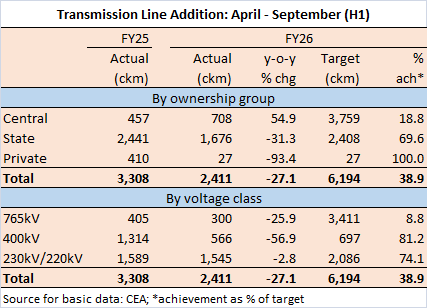

The under-achievement was most prominent in the 765kV voltage class. Just 300 ckm of such lines were commissioned in H1FY26, which was 26 per cent lower than the already-depressed 405 ckm in H1FY25. When seen against the planned addition of 3,411 ckm, the achievement in H1FY26 was just about 9 per cent. It may also be noted that during September 2025, not a single ckm of 765kV lines was added.
Transmission lines of 765kV are typically part of the interstate transmission system (ISTS) network – a space dominated by Power Grid Corporation of India Ltd (PGCIL) alongside private sector players. The entire addition of 300 ckm of 765kV lines in H1FY26 was by PGCIL.
However, was the Central PSU could achieve was nowhere close to the planned addition. For a frame of reference, PGCIL had planned to add a total of 3,380 ckm of lines in Q2 (July to September) of FY26 alone, albeit with a small contribution from other voltage classes, mainly 400kV.
In an address to investors on the Q1FY26 results, R.K. Tyagi, CMD, PGCIL, had admitted to right-of-way constraints frustrating the progress of transmission lines projects. Tyagi had also discussed several innovative steps that PGCIL was taking to mitigate RoW challenges. While some of these were on the project execution side, others were more “social” in nature. For instance, formation of all-women cells to engage with landowner families to settle land acquisition. (See related tndindia.com story dated August 4, 2025)
State government agencies did relatively better adding 1,676 ckm of lines, representing nearly 70 per cent of the overall achievement in H1FY26. However, when seen against the 2,441 ckm commissioned in H1FY25, the quantum added in the current year was down by over 30 per cent.
The private sector remained subdued during H1FY26 with just 27 ckm added in H1FY26, which, incidentally was completely in tune with the planned addition. Private sector contribution to transmission line addition is expected to surge in H2FY26 (October to March) with an anticipated volume of over 3,000 ckm of lines, largely coming from TBCB projects – largely interstate but with a small contribution of intrastate lines.
The depressed performance on the 765kV front was reflected in poor augmentation of the ISTS grid. In H1FY26, new line addition to the ISTS network was just 622 ckm as against 1,789 ckm put up on the intrastate grids.
Cumulative status
As of September 30, 2025, India’s total transmission line network (of 220kV or above) stood at 4,96,785 ckm; around 43 per cent of this was on the ISTS network. As of the same date, India’s total interregional transfer capacity was 1,20,340 MW, with 1,600 MW worth of new capacity added during H1FY26.
Note: This story takes into account transmission lines of 220kV or above, only