

PGCIL clinches Barmer HVDC scheme with winning tariff quote of over Rs.3,200 crore
- August 23, 2026
Power Grid Corporation of India Ltd (PGCIL) has won the Barmer HVDC interstate transmission system (ISTS) scheme, under TBCB, with a winning tariff quote of over Rs.3,200 crore.
A very reliable source indicated that PGCIL won the project having emerged L1 in the e-reverse auction (e-RA) that concluded on August 21, 2026.
PGCIL final winning quote was Rs.3,244.325 crore giving it L1 position at the end of the e-RA. It is further understood that PGCIL was L1 even based on initial price bids, with a quote of Rs.3,760.686 crore. Thus, PGCIL downwardly revised its initial price bid by around 14 per cent in a keenly-contested e-RA that lasted nearly 24 hours.
There was no official communication from PGCIL about the Barmer HVDC project, till the time of filing this story. In normal course, developers publicly announce winning of ISTS-TBCB schemes only after the letter of intent (LoI) is issued by the bid process coordinator. In the case of Barmer HVDC, RECPDCL is expected to issue the LoI to PGCIL sometime next week.
As reported by tndindia.com on August 12, 2026, bid process coordinator REC Power Development & Consultancy Ltd (RECPDCL) had qualified five aspirants, based on their technical bids, for opening of initial price bids. The names of those that made it to the e-RA stage – the number is typically restricted to four – are not yet available.
Second HVDC under TBCB
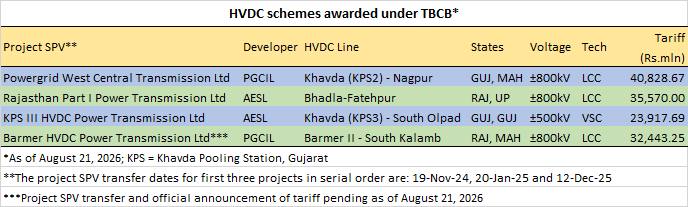
For PGCIL, the newly-won Barmer project is the second HVDC transmission scheme, won under the TBCB framework. In November 2024, the Central PSU had won the Khavda V-A HVDC project with an annual tariff quote of around Rs.4,083 crore. The Khavda V-A scheme, now housed under project SPV “Powergrid West Central Transmission Ltd,” continues to be India’s biggest ISTS-TBCB scheme till date, both in terms of project cost and annual tariff.
Transmitting 6 GW from Rajasthan to Maharashtra
With an estimated cost of Rs.24,974 crore, the Barmer HVDC scheme is formally termed as “Transmission system for evacuation of power from Rajasthan REZ Phase-IV (Part-5: 6 GW) [Barmer Complex] Barmer-II: 6 GW (Solar) (LCC Configuration)” and is currently incorporated under “Barmer HVDC Power Transmission Ltd,” a wholly-owned subsidiary of RECPDCL.
The project implementation period is estimated at 48 months for the first HVDC pole. The second pole will be commissioned six months thereafter (which is 54 months from zero date).
The objective of the HVDC scheme, operating at ±800kV and using LCC technology, is to transmit 6 GW of solar energy from Fatehgarh/Barmer complex in Rajasthan to South Kalamb in Maharashtra. Downstream networks already planned in Maharashtra will facilitate onward transmission.
PGCIL, 2; Adani, 2
As far as HVDC schemes under the TBCB framework are concerned, PGCIL and Adani Energy Solutions Ltd (AESL) are now at par with two schemes each, out of the four such awarded so far. (See table ahead). However, when it comes to tariff-based share, PGCIL has a slightly higher dominance. The total annual tariff associated with the four HVDC-TBCB schemes is an estimated Rs.13,276 crore, of which PGCIL has a 55 per cent share, and AESL, 45 per cent.
Impact on FY27 performance
By current thinking, the Barmer HVDC scheme will be, by far, the biggest ISTS-TBCB scheme, in terms of tariff, to be formally transferred to its winning developer in FY27. With result, PGCIL will most certainly, retain its tariff-based market leadership in FY27, even if loses out on a few schemes in the remaining months.
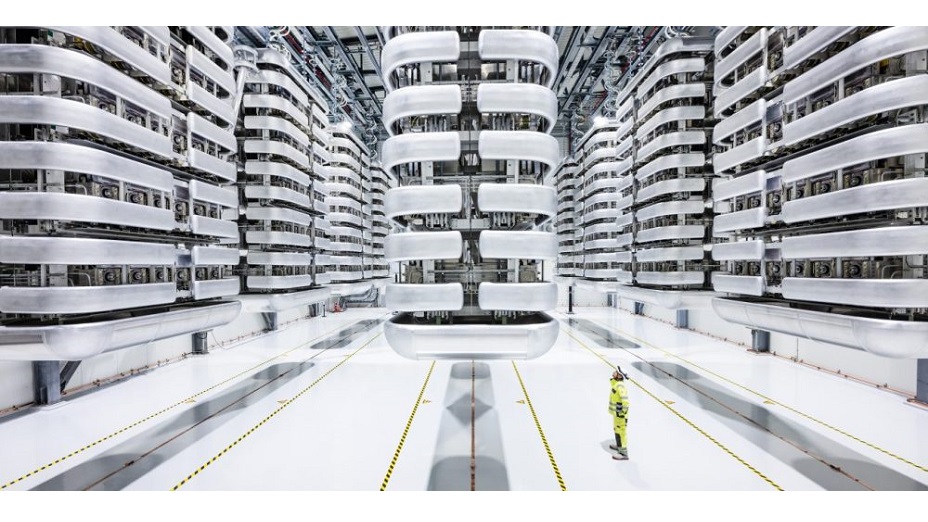
Featured photograph (source: Hitachi Energy India) is for representation only