

Bidder selection process initiated for major grid stability scheme in Northern Region
- October 23, 2026
Bid process coordinator PFC Consulting Ltd (PFCCL) has recently initiated the bidder selection process for a major interstate-TBCB scheme aimed at providing reactive compensation to the Northern Region (NR) grid.
By current timelines, the last date for submission of technical and financial bids (response to RfP) is December 28, 2026. Bids will be opened on the same date.
The scheme is termed as “Static/Dynamic compensation requirement in the Northern Region Grid” and is expected to commission in 24 months from the SPV transfer date.
PFCCL has newly incorporated a wholly-owned subsidiary “Northern Region Power Transmission Ltd” to house this interstate scheme. It is also learnt that VITS Total Power Solutions Pvt Ltd has been appointed as the technical consultant for the scheme.
With an estimated cost of Rs.4,378 crore, as assessed by the National Committee on Transmission (NCT), the project involves putting up STATCOM (static synchronous compensator) units as well as bus reactors at several existing substations in the NR grid.
Coverage
Substations owned by Power Grid Corporation of India Ltd (PGCIL) for STATCOM installations include 765/400kV Aligarh (Uttar Pradesh), 400/220kV Wagoora (UT of J&K), 765/400kV Jhatikara (Delhi) and 400/220kV Mandola (Uttar Pradesh). The 400/220kV 400/220kV Amargarh substation in UT of J&K and owned IndiGrid will also be covered. In each case, at least one STATCOM unit (±300 MVAr) with mechanically switched capacitors and/or reactors has been envisaged.
With respect to bus reactors, the substations entailed are: 765/400/220kV Agra, 765/400kV Orai (both owned by PGCIL and located in Uttar Pradesh), and IndiGrid’s 400/220kV Patran substation in Punjab.
Rationale
The project essentially aims to control voltage level in the NR grid. Weak grid strength (low short circuit ratio, SCR) in western Rajasthan RE complex and over/under voltage conditions in the NR grid have been longstanding subjects of discussion. At a meeting of National Committee on Transmission (NCT) in July 2026, it was informed that as a short-term measure to counter the situation, transmission lines are opened based on real-time grid conditions. However, issues of high voltage continued to persist.
Central Transmission Utility of India Ltd (CTUIL) suggested that synchronous condensers (SynCon) be installed at key pooling stations in Rajasthan – Bhadla-III, Ramgarh and Fatehgarh-IV – and STATCOMs and bus reactors at the substations discussed above.
NCT approved the STATCOM units and bus reactors, while directing CTUIL to undertake studies to find suitable alternatives for the proposed SynCon units. The SynCon units at the aforementioned three locations are therefore likely to come up as a separate scheme. It may be noted that a scheme to install SynCon units at the Fatehgarh-II pooling substation in Rajasthan has already been awarded under TBCB to PGCIL. This is India’s first scheme purely dedicated to SynCon units. PGCIL acquired the project SPV “Fatehgarh II Transmission Ltd” on August 28, 2026. (Learn more)
Second pure-STATCOM scheme
According to information available with tndindia.com, the Northern Region Power Transmission project discussed here will be the second ISTS scheme purely involving STATCOM units, to be developed under TBCB. In November 2024, PGCIL acquired “Khavda PS1 and 3 Transmission Ltd” (later renamed to Powergrid Khavda PS1 and 3 Transmission Ltd) – an ISTS-TBCB scheme envisaging STATCOM units at KPS1 and KPS3 in Gujarat. (KPS is Khavda Pooling Station). This scheme is currently under implementation with commissioning expected by March 2027, delayed from its original schedule of November 2026.
As can be easily appreciated, scheme purely devoted to STATCOM or SynCon units are “qualitative” schemes and do not envisage new basic transmission infrastructure – lines or substations.
It may be noted that the three schemes discussed in the story – Northern Region Power Transmission Ltd, Khavda PS1 and 3 Transmission Ltd and Fatehgarh II Transmission Ltd – are purely dedicated to reactive power compensation through deployment of STATCOM/SynCon units. However, there are several schemes that deal with STATCOM/SynCon units, but in conjunction with conventional infrastructure – transmission lines and transformation capacity.
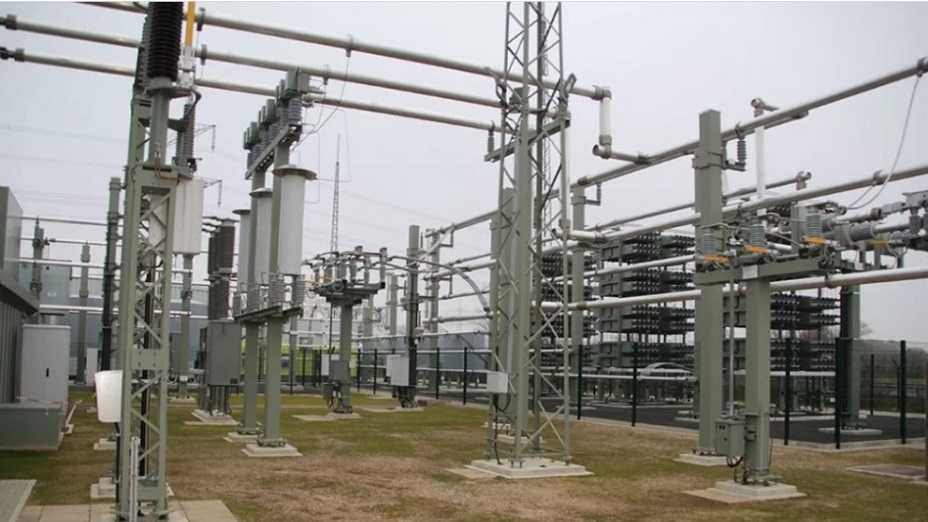
Featured photograph (source: Hitachi Energy) is for representation only