

EHV transmission line tower failure: 22 cases reported in January-June 2025
- October 24, 2025
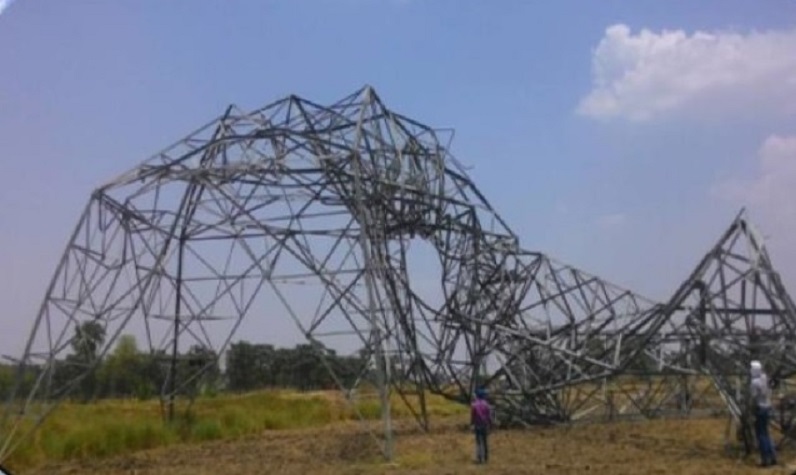
During the period January 1, 2025 to June 30, 2025, 22 cases of EHV transmission line failure due to towers were reported by 11 utilities to the Standing Committee of Experts constituted by the Central Electricity Authority (CEA).
In its newly-released report based on a meeting held on September 8, 2025, the Standing Committee said that these 22 cases of transmission line failure involved 75 towers – 59 of suspension-type and 16 of tension-type. Of the 16 tension-type towers, eight were of “Type B”, two of “Type C” and six of “Type D,” the report said. The scope of the Standing Committee covers EHV transmission lines (of voltage 220kV or above) only.
Suspension vs tension
 The report observed that the failure rate of suspension-type tower was much higher in comparison to tension-type tower. This may be because in normal terrain, generally, the number of suspension type tower in any particular line is much higher than that of Tension type tower. Further, the Suspension type towers are not designed to take horizontal forces in the longitudinal direction and hence the failures of one suspension type tower causes secondary failure of adjacent Suspension towers due to the pulling force of conductors. In view of above, the loading criteria for the Suspension type towers have been made more stringent and the longitudinal and transverse force acting on Suspension type towers under security condition has been increased in revised IS 802:2015, the report said.
Timely reporting of failure
During the meeting, the Chairperson of the Standing Committee expressed concern that many utilities are not intimating/notifying failure cases within 48 hours and are also failing to submit detailed failure reports within one month.
Age of transmission lines
He further highlighted the issue of tower failures occurring within 10 to 15 years of commissioning, whereas the design life of a tower is 35 years. It was noted that, out of 22 failure incidents, 16 were reported within 10 to 15 years of commissioning.
It is pertinent to observe that the 75 transmission tower failures reported in the first six months of 2025 is nearly equal to the total number of such failures during the entire 2024. Between January 1, 2024 and December 31, 2024, a total of 76 tower failures were reported to the CEA.
Manifestation of tower failure
The report provided the following summary of the various types of failures of EHV transmission line towers:
- Deformation in legs of towers and cage portion of bottom cross arm level
- Buckling at stub level leading to complete collapse of towers with/without damage to tower
- foundation
- Buckling above 1st panel (normal tower) level with/without damage to tower foundation
- Buckling from bottom cross arm level or top cross arm level or peak broken without any damage to lower portion of the tower and foundation
- Damage to foundation as well as to tower structure due to increased water level and additional
- force due to water flow/velocity in the river/soil erosion and inadequate protection to foundation of towers
- Shearing of stubs of leg members of towers
Reasons for failure
The Standing Committee Chairperson informed that in most tower failure incidents, the reasons reported by the utilities were high wind speeds, cyclonic winds, or heavy rainfall. Accordingly, the Chairperson stressed that while designing towers, due consideration must be given to terrain type, wind speed in the respective terrain, and areas prone to high wind activity to ensure longevity. Moreover, when citing wind speed as the cause of failure, utilities must substantiate the claim with supporting wind speed data.
The Chairperson therefore advised all utilities to develop in-house teams equipped with relevant tower design software to simulate, analyze, and address design issues in failed towers.
Failed lines
The 11 utilities that reported the aforementioned failures included PGCIL, RVPNL, THDCIL, GETCO, MPPTCL, UPPTCL, Renew, KPTCL, NTPC, NRSS XXXVI and AESL. (See key to abbreviations presented ahead). The 22 lines that experienced failure covered one line of 765kV, twelve of 400kV and nine of 220kV. The only 765kV line was the Fatehpur-Agra 2 line of PGCIL in Uttar Pradesh.
Coordination with IMD
It was highlighted in the meeting that Indian Meteorological Department (IMD) has already established a network of wind sensors at approximately 700 locations across India, each capable of capturing wind parameters, including speed, within a radius of 10 km. He further advised utilities to coordinate with the IMD, Airports Authority of India (AAI), nearest wind farms, or the State Irrigation Department to obtain wind speed data at failure locations, as wind has been reported as a major contributing factor to tower collapses by the utilities.
He further suggested that all utilities must ensure that new towers erected in replacement of failed ones, as well as spare towers procured, conform to the prevailing regulations, applicable standards, and the wind speed conditions of the respective area.
Cumulative status
From the period 2012, when the Standing Committee was constituted, up to June 30, 2025, a total of 964 cases of EHV transmission line towers have been reported. Here is how these failures were distributed across voltage levels and tower type:

Background
Under Section 73, Clause (l) of the Electricity Act, 2003, CEA constituted a Standing Committee of Experts in the field of design and operation of EHV transmission line towers from CEA, various transmission utilities and research/academic institutes to investigate the failure of 220kV and above voltage class transmission line towers and recommend measures to avert recurrence of such failures in future. The Committee was reconstituted in August 2012.
The objective of the Standing Committee is to investigate the causes of failures, deliberate the failures of transmission line towers of various power utilities, suggest remedial measures to prevent recurrence of such events in future and prepare a report which would serve as a repository of case studies of failures and suggested remedial measures for future.
All utilities are required to report any event of failure of 220kV and above voltage class transmission line towers within 48 hours, and submit a detailed report to CEA as per stipulated format covering reasons for failure and measures taken/to be taken to avoid recurrence of such failures. As part of this activity, CEA has been receiving reports of failures of various towers of 220kV and above voltage class transmission lines from power utilities.
Key to abbreviations:
PGCIL = Power Grid Corporation of India Ltd; RVPNL = Rajasthan Rajya Vidyut Prasaran Nigam Ltd; THDCIL = THDC India Ltd; GETCO = Gujarat Energy Transmission Corporation Ltd; MPPTCL = Madhya Pradesh Power Transmission Company Ltd; UPPTCL = Uttar Pradesh Power Transmission Corporation Ltd; Renew = Renew Transmission Ventures Pvt Ltd; KPTCL = Karnataka Power Transmission Corporation Ltd; NTPC = NTPC Ltd; NRSS XXXVI = NRSS XXXVI Power Transmission Ltd (a TBCB subsidiary of Resurgent Power Ventures); AESL = Adani Energy Solutions Ltd
Featured photograph (source: Central Electricity Authority) is for representation only