

India’s substation capacity addition during the first half (H1: April to September) of FY26 was up 74 per cent, year-on-year, but still met only two-thirds of the planned addition.
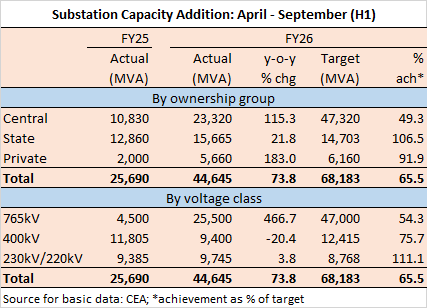
Latest statistics issued by Central Electricity Authority (CEA) reveal that India added 44,645 MVA of transformation capacity, considering voltage levels of 220kV or above only. This was 73.8 per cent more than the comparable achievement of 25,690 MVA in H1FY25.
However, when seen against the planned addition of 68,183 MVA, the achievement was just about 66 per cent.
Statistics shows that the shortfall was largely on account of under-performance by Central government utilities – mainly Power Grid Corporation of India Ltd (PGCIL).
 The only other Central PSU involved in power transmission infrastructure of 220kV or higher is Damodar Valley Corporation (DVC). For the entire FY26, there is no planned substation capacity addition by DVC. Therefore, PGCIL is fully representative of the Central government ownership group.
PGCIL added a healthy 23,230 MVA of substation capacity in H1FY26 including 14,000 MVA in Q2 (July to September) alone. Though this was more than twice the actual addition in H1FY25, it fell significantly short of the 62,005 MVA planned to be commissioned in H1FY26.
The state government sector as well as the private sector did relatively better, at least in terms of target achievement. With respect to their contribution to the actual substation capacity addition in H1FY26, they achieved less than PGCIL.
At 15,665 MVA, substation capacity addition by state government utilities overshot the targeted 14,703 MVA. Private entities added 5,660 MVA of transformation capacity, meeting 92 per cent of the planned addition.
PGCIL commissioned several substations – both greenfield and augmentation projects – in RE-rich zones of Gujarat (mainly Khavda) and Rajasthan. Most of these were through PGCIL’s TBCB subsidiaries. Of the 23,230 MVA commissioned by PGCIL, as much as 21,000 MVA came from 765kV substations, followed by 2,000 MVA in the 400kV class and the remaining 320 MVA in the 220kV category.
For the entire year FY26, PGCIL has planned to commissioned 62,005 MVA of substation capacity. With only around 38 per cent of the targeted achieved in the first half of the year, PGCIL will need to expedite project completions during H2 (October to March) of FY26. In fact, PGCIL is likely to witness significant substation capacity addition in Q3FY26 considering that there will be a spillover of the 38,000 MVA planned to be added in Q2FY26. [Actual addition by PGCIL in Q2FY26 was only 14,000 MVA.]
ISTS vs InSTS
Thanks to the widespread EHV substation capacity addition by PGCIL, supported by private entities, the H1FY26 period saw 27,820 MVA getting added to the interstate transmission system (ISTS) network. This was much larger than the comparable 16,825 MVA commissioned on the intrastate grids.
As of September 30, 2025, India had total transformation capacity of 1,382,158 MVA arising out of 220kV-or-higher substations. Of this, 42 per cent (or 583,705 MVA) was on the ISTS network. As of same date, an estimated 3,18,400 MVA of substation capacity was under construction arising out of ISTS-TBCB projects alone.
Also read: Substation capacity addition more than doubles, 765kV voltage class dominates
Featured photograph (source: Adani Energy Solutions Ltd) is for representation only