


The quantum of transmission line addition in the first quarter (Q1: April to June) of current year FY26 was less than 20 per cent of the planned addition.
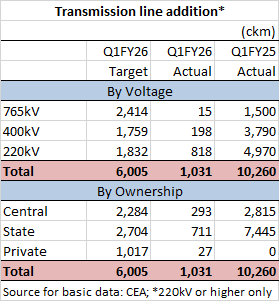
According to latest statistics released by Central Electricity Authority (CEA), the total transmission line addition of 220kV or above during Q1FY26 was just 1,031 ckm, meeting only 17 per cent of the planned addition of 6,005 ckm.
Further, the quantum of addition in Q1FY26 was nearly 90 per cent lower than the very respectable 10,260 ckm added in Q1FY25.
While the under-performance was conspicuous across all the voltage categories, it was most pronounced in the 765kV category where a paltry 15 ckm was achieved in Q1FY26 against the planned 2,414 ckm.
 Power Grid Corporation of India Ltd (PGCIL) was expected to commission 2,198 ckm of lines across all voltages in Q1FY26, against which it commissioned 293 ckm, comprising 15 ckm in the 765kV class, 136 ckm in the 400kV category and 142 ckm in the 220kV segment. Incidentally, the entire addition by PGCIL came through its TBCB projects.
The 142 ckm in the 220kV was commissioned by PGCIL’s TBCB subsidiary “Powergrid ER NER Transmission Ltd” that resulted in full commissioning of the overall ISTS-TBCB project “System strengthening scheme for Eastern and North Eastern Regions” spread over Bihar, Assam and Arunachal Pradesh.
In the 400kV category, only 198 ckm was added against the planned addition of 1,759 ckm. The achievement in Q1FY26 was nowhere close to the 3,790 ckm added in the first quarter of FY25. (See table)
The best performance in Q1FY26 was seen in the 220kV category where 818 ckm was added, largely driven by state utilities that saw the commissioning of 660 ckm.
The private sector could add just 27 ckm of lines in Q1FY26. Though this was technically better than the nil achievement in Q1FY25, it was a far cry from the 1,017 ckm of lines planned for addition. The entire addition of 27 ckm was seen in Rajasthan, including 11 ckm by an intrastate-TBCB scheme of Adani Energy Solutions Ltd. The remaining 16 ckm was commissioned by RE developer Juna Renewable Energy Pvt Ltd as pooling station connectivity for its solar power project in Bikaner district.
ISTS vs InSTS
Out of the 1,031 ckm of transmission lines added in Q1FY26, around 28 per cent (or 293 ckm) was on the interstate transmission system (ISTS) side while the remaining 72 per cent (or 738 ckm) was on the intrastate grid.
Target for FY26
For the full year FY26, the official target for transmission line addition currently stands at 24,400 ckm that implies a 72 per cent growth over the 14,203 ckm of actual addition in FY25. The private sector is expected to make a significant contribution of 6,404 ckm of new lines (including 3,870 ckm in the 765kV class) during FY25. This technically implies a near-doubling of its FY25 achievement of 3,272 ckm.
Cumulative status
As of June 30, 2025, India’s total transmission line network of 220kV or above was 4,95,405 ckm. The 220kV category dominated with a share of 43 per cent, closely followed by the 400kV category with 42 per cent. The 765kV category had a share of 11.5 per cent.
IR transfer capacity
As of June 30, 2025, the country’s total interregional (IR) transfer capacity stood enhanced to 1,20,340 MW, as against 1,18,740 MW on March 31, 2025. The increase in total IR capacity, at 1,600 MW, came about entirely on the ER-WR corridor. This in turn was due to the commissioning of the 136-ckm 400kV double-circuit line from PGCIL’s 400/220kV Jeypore substation in Odisha to the 220/132/33kV Jagdalpur substation of Chhattisgarh state transmission utility. This interregional line was commissioned by “Powergrid ERWR Power Transmission Ltd,” a TBCB subsidiary of PGCIL.
Also read: Transmission line addition fares poorly in May 2025
Featured photograph is for representation only