

India’s transmission line addition during the first five months (April to August) of FY26 met over 90 per cent of the target set for the period.
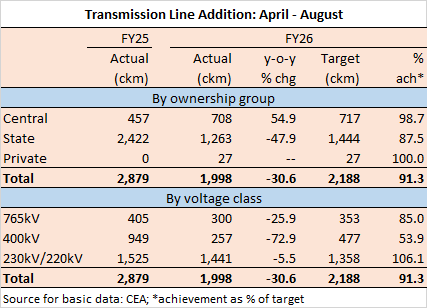
According to latest statistics released by Central Electricity Authority (CEA), India added a total of 1,998 ckm of transmission lines of voltages 220kV or higher during the April-August period of FY26 (denoted as 5MFY26). This was 91.3 per cent of the 2,188 ckm planned to be added in the said period.
 Though the target achievement appears respectable, it must be seen against the fact CEA recently effected a substantial downward revision in transmission line addition for FY26. The revised target stands at 15,382 ckm, 37 per cent lower than the originally envisaged 24,440 ckm. (Read T&D India’s Special Report dated August 22, 2025)
Transmission line addition during 5MFY26 was nearly 31 per cent lower than the 2,879 ckm added in the same period of FY25.
The year-on-year decline was most prominent in the case of state government utilities that could add only 1,263 ckm in 5MFY26, nearly 48 per cent lower than the 2,422 ckm commissioned in 5MFY25. With respect to the targeted 1,444 ckm in 5MFY26, achievement was 87.5 per cent.
Central government entities, mainly Power Grid Corporation of India Ltd (PGCIL), did reasonably well by commissioning 708 ckm of lines in 5MFY26. Not only was this 55 per cent higher than the 5MFY25 achievement of 457 ckm, it nearly met the 717-ckm target.
Bulk of the 1,998 ckm of lines added in 5MFY26 came from the 220kV voltage class with just 300 ckm of 765kV and 257 ckm of 400kV lines added in the period. The 1,441 ckm of 220kV lines added in 5MFY26, in fact, exceeded the planned addition of 1,358 ckm. However, it was 5.5 per cent lower than the 1,525 ckm achieved in 5MFY25.
PGCIL commissioned 622 ckm of transmission lines, accounting for 88 per cent of the total contribution of Central government entities in 5MFY26. Interestingly, the 622 ckm of lines commissioned by PGCIL during 5MFY26 covered all the voltage classes – 765kV (300 ckm), 400kV (180 ckm) and 220kV (142 ckm). Further, the entire 622 ckm added was part of PGCIL’s interstate projects awarded under the tariff-based competitive bidding (TBCB) framework.
ISTS vs InSTS
Of the 1998 ckm of lines commissioned in 5MFY26, the interstate transmission system (ISTS) network saw addition of 622 ckm. (This was entirely the contribution of PGCIL, discussed above). The remaining 1,376 ckm (or 69 per cent of the total) was commissioned on the intrastate grid.
Cumulative status
As of August 31, 2025, India’s total transmission line network (of 220kV or above) stood at 4,96,372 ckm. Most of these lines were of the 220kV type with a share of 42.8 per cent. The 400kV class came a close second with 41.7 per cent.
The intrastate transmission system (InSTS) had 2,81,336 ckm of lines, representing 56.7 per cent of the total transmission line network as of August 31, 2025. The share of the ISTS network, which was 43.3 per cent as of August 31, 2025, is poised to increase significantly in the coming years thanks to a robust under-construction pipeline.
As of August 31, 2025, an estimated 34,450 ckm of interstate lines were under construction through projects awarded under the TBCB route alone. Substantial addition is also expected by projects awarded to PGCIL and private entities, under the regulated tariff mechanism (RTM) framework.
Also read: Transmission systems for additional RE potential in Karnataka proposed
Note: HVDC lines have not been presented in the table as no such lines were added/planned in FY25 or FY26.
Featured photograph is for representation only