

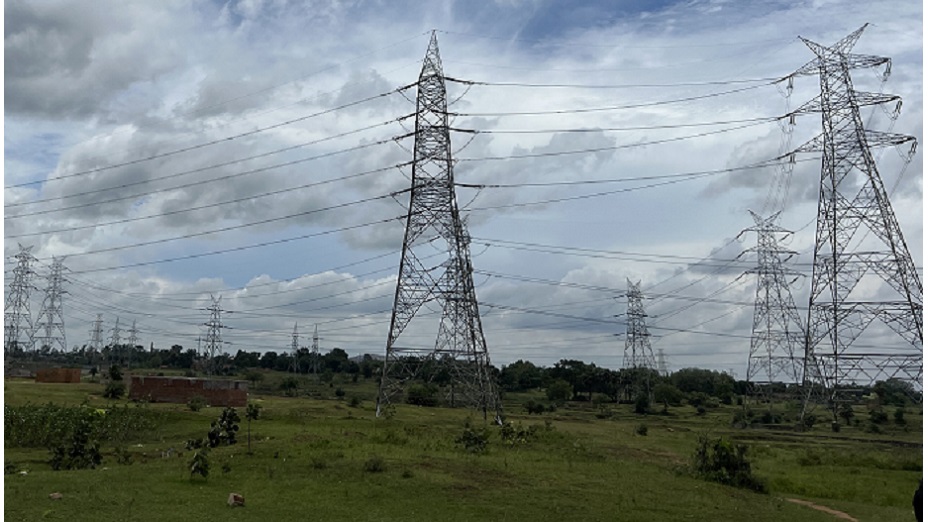
A very healthy growth of over 35 per cent is expected in transmission infrastructure addition during the current fiscal year FY27. The 765kV voltage class is expected to have a much higher share than 400kV and 220kV.
Latest statistics released by Central Electricity Authority (CEA) suggest that India’s transmission line addition in FY27 will be 36 per cent higher than the actual achievement in FY26. In terms of substation (transformation) capacity addition, the growth is pegged even higher at over 40 per cent. [This infrastructure includes that of 220kV or above, only]
The most striking aspect is that the 765kV voltage class will have the highest share in this projected FY27 addition – both in terms of transmission lines and transformation capacity.
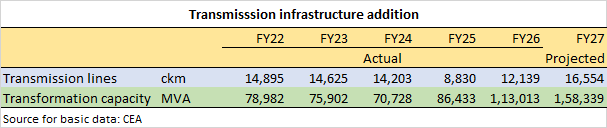
Fiscal year FY27 will see 16,554 ckm of new transmission lines – the highest in any fiscal year so far. Of this, nearly 39 per cent will be from the 765kV class. Speaking of transformation capacity addition, 158,339 MVA (roughly 158 GVA) is the projected addition for FY27 – again, the highest in any fiscal year so far. The 765kV class is expected to account for over 44 per cent of this addition.
Seen from the ownership angle, across all voltage classes, state utilities are expected to account for 44 per cent of the transmission line addition projected for FY27. However, much of their contribution will be in the 220kV class.
With respect to transformation capacity, the highest contribution is seen coming from Central utilities that are projected to have a share of 37 per cent. Within this ownership group, Power Grid Corporation of India Ltd (PGCIL) will account for almost the entire quantum, with very little contribution expected from the only other Central PSU – Damodar Valley Corporation (DVC).
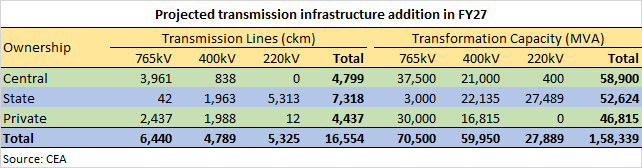
In terms of physical volume, PGCIL is expected to 58,500 MVA of new transformation capacity in FY27, which would indeed be lower than the 62,005 MVA actually commissioned in FY26. The private sector is expected to play a leading role with 46,815 MVA of transformation capacity addition projected in FY27, growing sharply from 13,690 MVA in FY26.
No new HVDC-based transmission infrastructure – lines or substations – is expected in FY27. The last time that India saw HVDC-based transmission infrastructure addition was in FY21. This was associated with the Raigarh-Pugalur-Thrissur HVDC system that introduced new ±800kV and ±320kV HVDC lines and converter stations to the national grid.
Performance in FY27
The current fiscal year, FY27, appears to have got off to a promising start. Transmission line addition in April 2026, at 901 ckm, was higher than the planned 668 ckm. With respect to transformation capacity addition, the April 2026 achievement stood at a very respectable 11,325 MVA, nearly twice the 5,875 MVA anticipated.
Also read: Healthy growth in Q4 order inflow for Hitachi ABB Power Grids in India