

During the first two months of the ongoing fiscal year FY27 (2M: April to May), over 18 GVA of new transformation capacity was commissioned, latest statistics by Central Electricity Authority (CEA) suggest.
During 2MFY27, a total of 18,515 MVA of new transformation (substation) capacity was commissioned, considering the voltage class 220kV or higher. The 765kV category accounted for over 50 per cent of this addition.
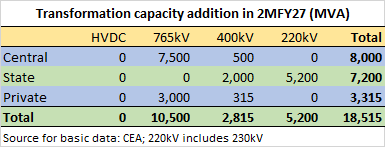 The achievement in 2MFY27 also exceeded the planned addition of 12,564 MVA by a wide margin.
Transformation capacity added in the 765kV category – at 10,500 MVA in 2MFY27 – was dominated by Power Grid Corporation of India Ltd (PGCIL) contributing 7,500 MVA. The remaining came from the private sector.
The healthy performance in the 765kV class had a positive bearing on transformation capacity addition on the ISTS side. During 2MFY27, a total of 11,315 MVA of new substation capacity was added on the interstate grid, accounting for over 60 per cent of the total addition.
 In the 400kV class, however, the 2MFY27 achievement of 2,815 MVA fell short of the planned 4,815 MVA. Both PGCIL and the private sector fell short of their respective targeted additions.
The 220kV/230kV voltage category saw 5,200 MVA of new transformation capacity added in 2MFY27, entirely by the state government sector. The planned addition of 3,249 MVA was easily surpassed.
Target for FY27
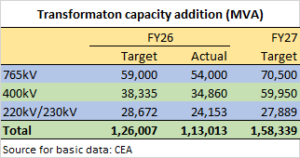
For the entire fiscal year FY27 (April 1, 2026 to March 31, 2027), the target for transformation capacity stands at 158,339 MVA (around 158 GVA). This is mainly seen coming from the 765kV and 400kV categories, boding well for interstate grid development. In FY26 (full year), substation capacity addition was 113 GVA, falling 10 per cent short of the planned 126 GVA.
Impact of intrastate-TBCB projects
Several states, led by Maharashtra, have embarked on the TBCB philosophy for development of intrastate grid projects. Majority of these projects involve 400kV substations, and in some cases, even 765kV. It is therefore anticipated from FY28 onwards, the build-up of 400kV and 765kV transformation capacity will start making meaningful contribution to intrastate grid development as well.
Featured photograph is for representation only