

Bharat Electricity Summit 2026 concludes with roadmap for future-ready power sector
- March 23, 2026
The maiden edition of the Bharat Electricity Summit (BES) successfully concluded on March 22, 2026, bringing together policymakers, global experts, industry leaders, investors, and innovators to deliberate on the future of the power sector and accelerate the global clean energy transition.
The Summit witnessed wide-ranging discussions, high-level bilateral engagements, and significant business interactions, reinforcing India’s leadership in the global energy ecosystem.
Exceptional response
The Summit witnessed an exceptional response, with over 35,000 exhibition attendees, 28 States/Union Territories, 200+ exhibiting companies including 80+ start-ups, 6,000+ delegates, 300+ speakers, and 100+ conference sessions, reflecting its scale and global significance.
Electricity: A common resource
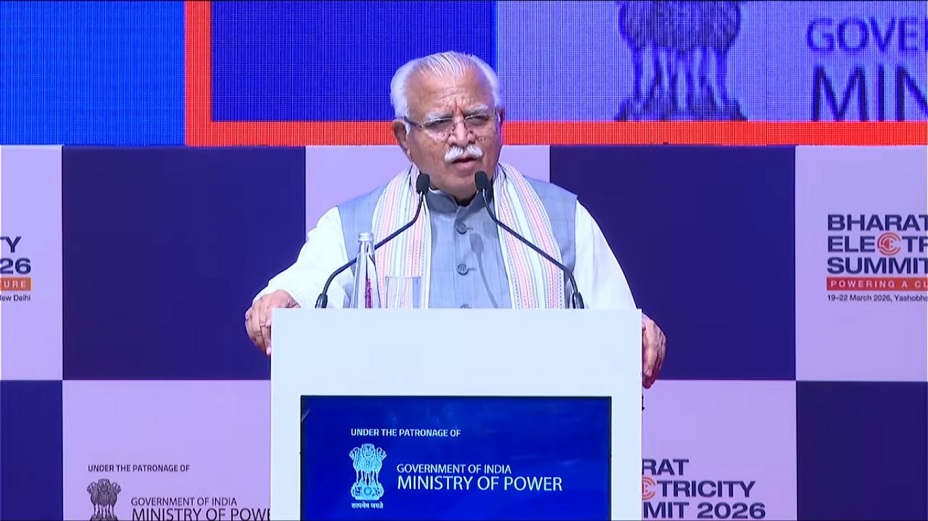
While giving his valedictory address Manohar Lal, Union Power Minister noted that the Summit was extremely successful and saw impressive participation from different stakeholders of the power sector. Despite being the first Electricity Summit, it saw unprecedented participation and meaningful discussions. In particular, he said that he was particularly delighted with the participation of the Startups at the Summit and the great innovation in the sector they would bring.
He said that India has a vision of Viksit Bharat by 2047 and for achieving this vision, electricity is a common resource that is needed by all economic stakeholders and citizens. Under Saubhagya Yojna we succeeded in ensuring that electricity has reached all nook and corners of the country.
Speaking on the importance of solar energy and cooperation across countries, Shri Manohar Lal noted the words of Prime Minister Narendra Modi – One Sun, One World, One Grid. These words he said, points to the need for working together as one global family. Our focus has to be on sustainability and thus expansion of renewable energy including solar energy is critical.
He said that during the Summit there were fruitful discussions with many countries and especially African nations. It emerged clearly that India and the African nations have a win-win possibility of cooperating in the power sector and beyond.
Manohar Lal noted that there is a need to strengthen discoms through different actions and reforms. He noted that during the Summit the discoms expressed a strong willingness to take necessary actions to improve their operations and financial situation. He said that the intended reforms in the sector includes adoption of smart meters, cost reflective tariffs.
The Minister also announced that Next Edition of BES will be held in 2028 in Gandhinagar, Gujarat.
Three key insights
Speaking at the Valedictory Session, Shripad Naik, Minister of State for Power and MNRE said what stands out most clearly from our deliberations in the Summit is that: India’s power sector is not merely expanding — it is advancing through a deeply coordinated federal architecture, where national vision and state-led execution are seamlessly aligned.
Naik said that from this Summit, three key insights emerge. First, states are emerging as engines of innovation, shaping renewable expansion and policy evolution. Second, distribution reforms are gaining tangible momentum, strengthening the last mile of reliable electricity delivery. Third, our transition is becoming integrated and system-driven, with renewables, storage, transmission, and digital technologies evolving as one cohesive ecosystem.
Strong capex pipeline
Addressing the gathering, Pankaj Agarwal, Secretary (Power), highlighted that discussions with industry bodies have indicated an estimated Rs.32,000 crore capex pipeline by manufacturers in the power sector. He emphasised the need for system-level evaluation of power costs to ensure affordability, and underscored the urgency of rapidly scaling up energy storage capacities for effective integration of renewable energy.
Reports released
Three reports were released on the occasion:
- Rating Regulatory Performance of States and Union Territories 2025 by Power Foundation of India
- Ash Generation and Utilisation at coal/lignite-based Grid Connected thermal power stations for 2024-25 by Central Electricity Authority
- Establishing a Sodium-ion Battery Ecosystem in India – Leveraging New Technologies to Strengthen Component Manufacturing by Council on Energy, Environment and Water.
Key Highlights of the Summit
- India’s power sector continues to demonstrate unprecedented growth and transformation:
- Installed capacity has reached over 520 GW, with one of the fastest expansions globally.
- Transmission network has expanded to over 5 lakh circuit kilometres
- Renewable energy capacity has grown significantly, with solar capacity increasing from 2.8 GW in 2014 to over 143 GW today.
- Electricity demand is projected to grow by over 30 per cent by 2030, driven by emerging sectors such as AI-enabled data centres and electric mobility.
The Minister of Power emphasised that while thermal power remains critical for grid stability, renewable energy will drive long-term sustainability, supported by storage, grid modernisation, and policy reforms.
Ministerial Meeting with States/UTs
- A high-level Ministerial meeting chaired by the Union Minister of Power resulted in the following priority action areas:
- Strengthening financial viability of discoms through structural and operational reforms
- Ensuring cost-reflective tariffs with targeted subsidies
- Accelerating smart metering rollout nationwide
- Securing adequate generation capacity tie-ups for future demand
- Fast-tracking nuclear power development to meet long-term energy security goals
Strategic Sessions – Key Takeaways
Several strategic sessions explored critical themes shaping the future power landscape:
- Centre-State Coordination: Emphasis on policy alignment and faster project execution
- Green Hydrogen & Emerging Fuels: Positioning India as a global hub for green industrial fuels
- AI-driven Power Systems: Enhancing grid intelligence, cybersecurity, and operational efficiency
- Nuclear Energy: Scaling reliable, clean baseload capacity
- Electrification & Power Markets: Enabling low-carbon growth through efficient trading systems
- Financing Sectoral Growth: Mobilising trillions in investments through bankable frameworks
- Energy Storage: Addressing rapid growth in storage requirements (expected to increase 5x by 2031–32)
- Make in India for the World: Strengthening domestic manufacturing for global clean energy supply chains
Discussions highlighted that India’s long-term energy transition may require investments exceeding $22 trillion by 2070, with significant opportunities in generation, transmission, storage, and digital infrastructure.
Infrastructure, Storage and Market Developments
- India needs to add over 1.37 lakh circuit km of transmission lines by 2030, with investments of around Rs.9 lakh crore
- Energy storage requirements are expected to rise sharply, with pumped storage potential of over 200 GW
- Battery Energy Storage Systems (BESS) are emerging as a key solution for peak demand management
- Renewable energy tariffs and market mechanisms continue to evolve, improving long-term price discovery and investor confidence
- The Indian Carbon Market Portal was launched, with trading expected to begin shortly, marking a major step in climate finance
Digital Transformation
Digital transformation emerged as a defining force, with the power sector increasingly leveraging Artificial Intelligence, Machine Learning, and digital twins to move towards predictive and intelligent grid operations. The concept of “India Energy Stack,” inspired by the success of digital public infrastructure, aims to create seamless, interoperable energy systems. Initiatives such as smart metering and rooftop solar adoption are empowering consumers to become “prosumers,” actively participating in the energy ecosystem.
State-Level Leadership and Initiatives
States showcased ambitious roadmaps:
- Gujarat: Renewable capacity target of 190 GW by 2047
- Andhra Pradesh: Integrated clean energy hub with investments exceeding ₹6 lakh crore
- Maharashtra: Demand projected to reach 280 TWh by 2030, with large-scale capacity expansion
- Bihar: Advancing storage and grid infrastructure with structured investment pipelines
- Delhi: Transitioning towards a high-renewable, storage-integrated urban power system
Global Cooperation and Bilateral Engagements
The Summit facilitated multiple high-level bilateral meetings with countries including Malawi, Tajikistan, Mauritius, Kyrgyzstan, and Russia, as well as industry stakeholders such as Africa50 and international delegations. These engagements focused on: cross-border electricity trade; renewable energy collaboration; transmission infrastructure development; and, capacity building and technology transfer
The India-Africa Strategic Meet further strengthened partnerships, with focus on expanding renewable energy, grid modernisation, and last-mile connectivity across the continent.
Business Outcomes
- Over 1,200 buyer–seller meetings were conducted
- Business enquiries exceeding Rs.517 crore (~$55 million) were generated
Conclusion
The Bharat Electricity Summit 2026 has set a clear direction for India’s power sector: anchored in resilience, energy transition and global leadership. The Summit reaffirmed India’s commitment to building a future-ready, technology-driven, and investment-friendly energy ecosystem, while supporting the energy needs of both the nation and the Global South.
The outcomes of the Summit will contribute significantly to shaping policy, strengthening partnerships, and accelerating the transition towards a reliable, affordable, and clean energy future.
Also read: Bharat Electricity Summit 2026
Featured photograph shows Manohar Lal, Union power minister, giving his valedictory address at the Bharat Electricity Summit 2026 (Photo: bharatelectricitysummit.com)