

The option of using HVDC-based power transmission technology for the mega transmission scheme to evacuate 5 GW of renewable energy from Leh in UT of Ladakh is now ruled out.
In the latest meeting held by National Committee on Transmission (NCT) recently, it was agreed that HVDC technology would be infeasible for various technical reasons.
Moreover, the only other alternative – that of using EHVAC – would be pursued only after Power Grid Corporation of India Ltd (PGCIL) completes detailed studies on the matter.
As reported by tndindia.com on August 6, 2025, R.K. Tyagi, CMD, PGCIL, had explained that HVDC technology was proving infeasible as only one HVDC OEM supplier expressed interest in the project that was supposed to use VSC-based HVDC technology. Even here, apprehensions were voiced on whether HVDC technology would work in hostile geographic and climatic conditions.
During the recent NCT meeting, PGCIL submitted that it had carried out front end engineering design (FEED) studies at both network level and equipment level. A primary conclusion derived was that the complex geography of the Pang pooling station that is at an altitude of 4,700m and subject to sub-zero temperatures that could even reach -35°C, no VSC-based HVDC technology would be available or feasible.
It has now been decided that EHVAC transmission systems would be exclusively used, albeit with more studies. Even here, as reported in tndindia.com’s story referred to earlier, there were concerns about the use of synchronous condensers (SynCons) that will be critical in achieving much needed dynamic reactive compensation, as the transmission system would be dealing with RE power.
PGCIL, as decided in the NCT meeting, will carry out studies regarding the use of EHVAC with respect to equipment needed and firmness of design. In parallel, the Union ministry of new & renewable energy (MNRE) will engage with RE developers to get their feedback on the working of inverters in areas of high altitude and low temperature, as well as on the use of SynCons. Central Transmission Utility of India Ltd (CTUIL), in consultation with CEA, will review the transmission scheme to enhance system stability, especially ensuring supply of green energy to Himachal Pradesh.
NCT will be revisiting the project in a subsequent meeting after due feedback from PGCIL, MNRE and CTUIL, it is learnt.
Project outline
The ISTS scheme is termed as “Transmission system for evacuation of 5 GW RE power from Renewable Energy Parks in Leh.” The project is proposed for implementation by PGCIL under the regulated tariff mechanism (RTM) route.
Original design (HVDC + EHVAC)
In the original design, where HVDC technology was being considered, the project involved putting up a ±350kV VSC-based system between Pang Pooling Station (in UT of Ladakh) and Kaithal Pooling Station (in Haryana). The two pooling stations would also be developed as part of the project.
There was also an AC system strengthening in Ladakh to provide RE power to UT of Ladakh and UT of J&K through the 220kV Pang-Leh single-circuit line. Besides, an EHVAC system for dispersal of power to load centres towards Modipuram (Meerut district, Uttar Pradesh) at 765kV and towards Bahadurgarh (Jhajjar district, Haryana) at 400kV, was also part of the overall project.
New design (Only EHVAC)
- A new 400/220kV pooling station would be built at Pang (to be known as Pang PS). It would be interconnected at 400kV level to three pooling stations owned by RE developers – referred to as PS1, PS2 and PS3 – for integration of RE power.
- A new 400/220kV pooling station will be developed at Sundernagar (Mandi district, Himachal Pradesh) that will be connected to Pang PS for evacuation of power. (It may be mentioned that supply green energy to Himachal Pradesh is also among the primary objective of the overall scheme).
- The 400kV Sundernagar PS will be interconnected to 400kV Saharanpur substation in Uttar Pradesh and to the Kaithal pooling station in Haryana, at 400kV level. [The 765/400kV Kaithal PS will also come up as a new transmission element envisaged in the overall project.]
- Kaithal PS will be interconnected to Bahadurgah substation (Haryana) and Modipuram substation (Uttar Pradesh) through 400kV double-circuit lines.
- A 220kV line from Pang PS to Leh will provide RE power to the UT of Ladakh and UT of J&K.
- Several substations – both existing and proposed – will be equipped with SynCon units to provide voltage stability.
- The overall scheme for transmitting 5 GW of RE power from Leh will be trifurcated into three phases of 1.67 GW, 2.33 GW and 1 GW, respectively. The first two phases will cover all the transmission elements envisaged in the overall project. The third phase, which will involve additional SynCons and 400kV interconnections, will be implemented based on the operational experience derived from the first two phases.
Also read: HVDC chosen over BESS for Rajasthan RE evacuation scheme
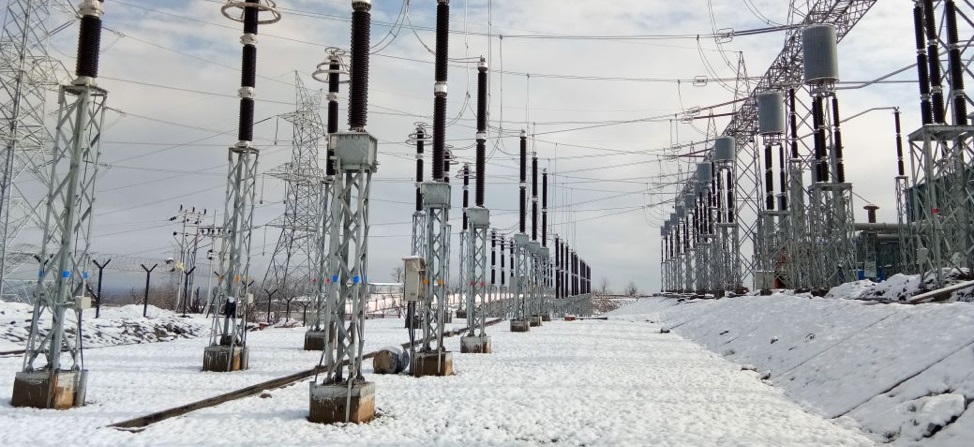
Featured photograph is for representation only