

Plan outlay of power CPSUs to cross Rs.1-trillion mark in FY27, PGCIL tops
- February 2, 2026
The aggregate plan outlay of all Central public sector undertakings (CPSUs) is expected to cross Rs.1-trillion (Rs. 1 lakh crore) during the fiscal year FY27 (April 1, 2026 to March 31, 2027).
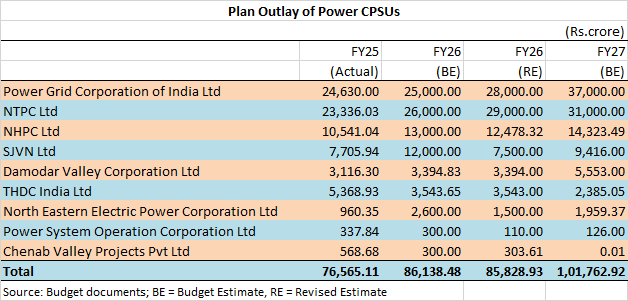
According to official Union Budget 2026 documents, the overall plan outlay, which can be interpreted as the capital expenditure (capex), of all nine CPSUs under the power ministry is budgeted at Rs.1,01,762.92 crore. This will be 18.6 per cent higher than the Rs.85,828.93 crore in FY26 (BE: budget estimate).
Significantly, this entire plan outlay of FY27 is expected to come from internal and extra-budgetary resources (IEBR) without any budgetary support. This means that these nine CPSUs will raise resources on their own, mainly through domestic and international borrowing.
The aggregate capex of power CPSUs in the current year FY26 is expected to be Rs.85,828.93 crore as per the revised estimates (RE). This would be marginally lower by 0.4 per cent than the Rs.86,138.48 crore envisaged in the previous year’s budget.
Three CPSUs — Power Grid Corporation of India Ltd (PGCIL), NTPC Ltd and NHPC Ltd — are expected to lead the capital expenditure programme in FY27. These three entities will account for over 80 per cent of the aggregate outlay of all power ministry CPSUs in FY27. It may be noted that Nuclear Power Corporation of India Ltd (NPCIL) does not come under the power ministry. It falls under the Department of Atomic Energy, directly under the Prime Minister’s charge.
PGCIL to lead
Power Grid Corporation of India Ltd (PGCIL) is expected to have a plan outlay of Rs.37,000 crore in FY27, making it the biggest power CPSU in this regard. This outlay will be 32 per cent higher than the Rs.28,000 crore in FY26 (RE: Revised Estimate).
PGCIL’s capex in FY26, at Rs.28,000 crore, will exceed the FY26 budget estimate (BE) by 12 per cent. In the first half (H1: April to September) of FY26, PGCIL’s capex was Rs.15,385 crore – up 54 per cent from Rs.10,002 crore, year-on-year. PGCIL’s capex figures for 9MFY26 (April to December) are expected to be released soon.
However, PGCIL has been falling short of its capitalization targets due to delayed commissioning of projects. In H1FY26, PGCIL’s capitalization was just around Rs.4,000 crore while the FY26 capitalization target stands at Rs.20,000 crore. Nevertheless, thanks to a slew of projects getting commissioned during Q3FY26, PGCIL is likely to bridge the target deficit during the third and fourth quarters of FY26. [Read tndindia.com story dated January 17, 2026.]
The opportunity for equipment suppliers catering to PGCIL projects is therefore estimated at Rs.18,500 crore in FY27, given that in a typical transmission project 50 per cent of the total outlay is for equipment, followed by 30-35 per cent for civil work and erection. Land cost is typically taken as 15-20 per cent of the total project cost.
Power ministry schemes
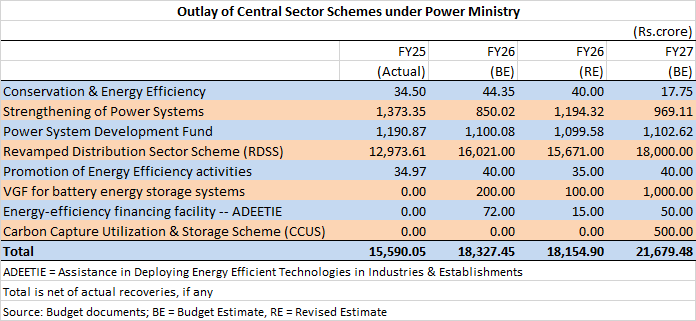
The combined outlay of Central sector schemes under the power ministry is projected at Rs.21,679.48 crore in FY27, up 19.4 per cent from Rs.18,154.90 crore in FY26 (BE). Almost the entire outlay will be in the form of revenue expenditure.
A new addition to power ministry-related Central schemes is the “Carbon Capture Utilization & Storage (CCUS) Scheme” for which the budget has provided Rs.500 crore for FY27.
Union finance minister Ms Nirmala Sitharaman, in her budget speech on February 1, 2026, had said, “Aligning with the roadmap launched in December 2025, CCUS technologies at scale will achieve higher readiness levels in end-use applications across five industrial sectors, including, power, steel, cement, refineries and chemicals. An outlay of Rs.20,000 crore is proposed over the next five years.”
The Revamped Distribution Sector Scheme (RDSS) will continue to be the flagship scheme with an enhanced outlay of Rs.18,000 crore in FY27 (BE), up 15 per cent from Rs.15,671 crore in FY26 (RE). In FY25, expenditure on RDSS was Rs.12,974 crore.
This year’s budget has significantly hiked the viability gap funding (VGF) for battery energy storage system (BESS) projects. In FY27, the Centre will spend Rs.1,000 crore on this account, pointing to accelerated BESS tendering activity in that year. Expenditure on VGF for BESS projects for the current year, FY26, is expected to be Rs.100 crore, just half of what was estimated in the previous year’s budget.
Green Energy Corridor
During FY27, Central government outlay on the Green Energy Corridor (GEC) is expected to be Rs.599.99 crore in FY27. This will be unchanged from the FY26 (BE) level. However, in FY26, the revised estimate for GEC expenditure stands at Rs.800 crore, according to the latest budget documents.
The GEC is a combination of interstate (ISTS) and intrastate (InSTS) schemes meant for evacuation of renewable energy. While the GEC, with respect to the ISTS grid, was completed in March 2020, work on the InSTS side is currently underway. Even here, Phase-I of the project has been completed, and what is currently under implementation, is Phase-II that is taking place ten RE-rich states — Andhra Pradesh, Gujarat, Rajasthan, Himachal Pradesh, Karnataka, Maharashtra, Madhya Pradesh, Tamil Nadu, Kerala and Uttar Pradesh. Transmission infrastructure covering over 10,000 ckm of lines and more than 27 GVA of transformation capacity has been envisaged under this phase.
Though the GEC essentially involves development power transmission infrastructure, it falls under the Union ministry of new & renewable energy (MNRE) as the project is dedicated to renewable energy evacuation. MNRE, it is understood, provides up to 40 per cent of the capital cost as Central grant assistance, to state transmission utilities for implementing projects under GEC.
Featured photograph is for representation only