

Ultra-high voltage 1,150kV interregional corridor, linking western and eastern grids, under discussion
- October 15, 2026
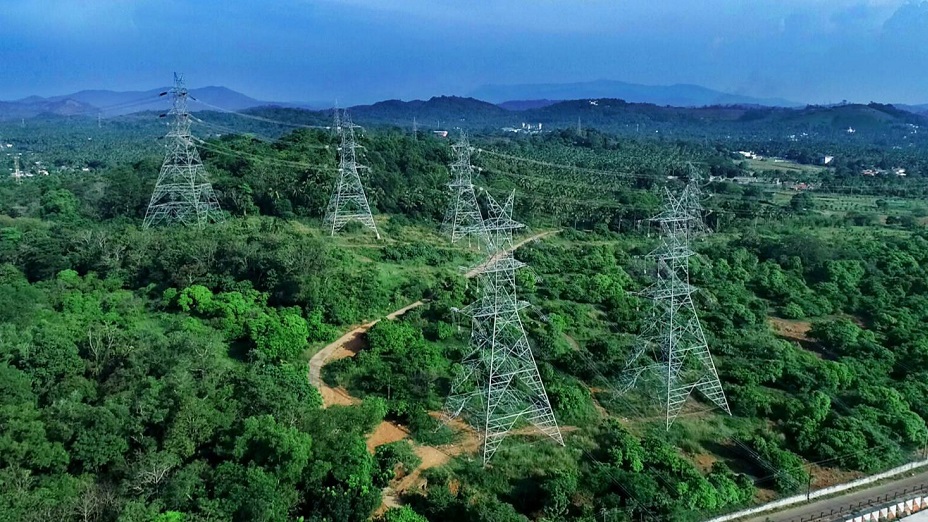
A new ultra-high voltage alternating current (UHVAC) corridor, linking the western region (WR) and eastern region (ER) grids, is under discussion.
It is reliably learnt that this proposed corridor was deliberated upon during a special joint CMETS meeting of Western, Eastern and Northern Region held last month. CMETS stands for “Consultation Meeting for Evolving Transmission Schemes.” Such meetings are regularly held by Central Transmission Utility of India Ltd (CTUIL) with stakeholders concerned.
The proposed UHVAC corridor will operate at a nominal voltage level of 1,150kV that will offer substantially higher transmission capacity compared to the existing 765kV level, which is currently the highest deployed as far as alternating current (AC) systems are concerned.
It is important to note that a technical committee constituted by the Central Electricity Authority (CEA) has recommended the introduction of 1150kV transmission systems in India. Further, CEA’s very newly-introduced “Manual on Transmission Planning Criteria, 2026” was essentially brought out to address 1,150kV systems. (Read tndindia.com story dated October 14, 2026)
The proposed corridor is expected to facilitate bulk power evacuation and long-distance transfer of large upcoming generation with enhanced reliability, lower transmission losses, and improved RoW utilization. The significantly higher power carrying capability of the 1150kV network also minimizes the need for multiple EHV transmission corridors, resulting in a more efficient and optimized transmission infrastructure.
Mode of implementation
In normal course, projects deliberated at CMTES meetings are subsequently taken up by the National Committee on Transmission (NCT) where the project parameters, including the mode of implementation (whether RTM or TBCB), are finalized.
Corridor details
Based on generation and demand assumptions, a 1,150kV transmission backbone has been proposed that will originate in Maharashtra (WR) and eventually reach West Bengal (ER), traversing Chhattisgarh and Odisha en route, also touching upon Bihar and Jharkhand.
In Odisha, for instance, substantial growth in electricity demand is envisaged from the industrial sector covering segments like green hydrogen/green ammonia, steel, petrochemicals, solar PV manufacturing and electric vehicle (EV) manufacturing.
Thermal power in Chhattisgarh and RE generation in Maharashtra (especially the Solapur region) are being considered as the main sources for power transfer to the ER grid. Solar generation from Rajasthan will also be an important source and will come into play in conjunction with two associated HVDC schemes. Similarly, hydropower generation from the northeastern region (NER) grid will be pooled into the WR-ER corridor through another HVDC link. The associated HVDC systems have been discussed ahead.
The proposed corridor will primarily involve nine new substations and eight transmission lines (one upgrade and seven new), all of 1,150kV rating. The corridor will have a total length of around 3,750 ckm and aggregate transformation capacity of 66,000 MVA (or 66 GVA).
The nine 1,150kV substations, which will effectively act as the nodes of the corridor, are:
- 1,150/400kV and 765/400kV, Aurangabad (New) in Maharashtra
- 1,150/400kV Wardha (New) in Maharashtra
- 1,150/765kV Rajnandgaon in Maharashtra
- 1,150/765kV Raigarh (Kotra-II) in Chhattisgarh
- 1,150/400kV Bolangir (New) in Odisha
- 1,150/765/400kV Begunia in Odisha
- 1,150/400kV Jeypore-2 in Odisha
- 1,150/400kV Chaibasa (New) in Jharkhand
- 1,150/400kV Basantpur (New) in West Bengal
As per available information, the proposed WR-ER corridor will not be contiguous but will bifurcate at Raigarh (Kotra-II) with one arm extending towards Chaibasa and Basantpur, and the other towards Bolangir, Begunia and Jeypore-2.
The corridor is proposed to have seven new 1,150kV lines, connecting the various substations involved. One existing line, namely the 400kV Aurangabad (New) – Wardha (New) line, will be uprated to 1,150kV level.
It may be noted that the overall transmission line length of around 3,750 ckm relates only to the 1,150kV lines, and excludes the downstream interstate/intrastate network. For instance, the 1,150/765/400kV Begunia substation in Odisha will be linked to the intrastate substations of Khuntuni and Mendhasal (owned by state transco OTPCL) as well as to the Paradeep and Gopalpur substations that are coming up as part of the interstate transmission system (ISTS) network.
HVDC links
The proposed WR-ER corridor will be connected to the following HVDC links so as to receive RE power from Rajasthan and hydropower from the northeastern region (NER) grid:
- ±800kV, 6,000 MW Ramgarh-II [Rajasthan] – Aurangabad (New) [Maharashtra] HVDC (1,200 km)
- ±800kV, 6,000 MW Bhadla-IV [Rajasthan] – Raigarh (Kotra-II) [Chhattisgarh] HVDC (1,350 km)
- ±800kV, 6,000 MW Roing [Arunachal Pradesh] – Jamshedpur [Jharkhand] HVDC (1,550 km)
The Jamshedpur HVDC terminal will ultimately be linked to the upcoming 1,150kV EHVAC corridor via the upcoming 1,150/400kV Chaibasa (New) substation in Jharkhand, it is learnt.
Two-phases
The overall WR-ER corridor is proposed to come up in two phases. In the first, five substations (numbered #4, #5, #6, #8 and #9 in the aforementioned list of substations) and associated lines will be developed. The ±800kV, 6,000 MW Bhadla-IV– Raigarh (Kotra-II) HVDC link will also form part of the first phase.
WR-ER electricity exchange
During FY26 (full year: April to March), the interregional electricity transfer between the two regional grids was comparable. Transfer from WR to ER was around 11,437 MU (million kWh or GWh) while that in the reverse direction was 12,194 MU. For a frame of reference, the total interregional electricity transfer between all the regional grids – NR, WR, ER, SR and NER – was 253,006 MU in FY26.
As of August 31, 2026, India’s total interregional transfer capacity stood at 120,340 MW, out of which the ER-WR corridor accounted for 22,790 MW, or around 20 per cent.
Featured photograph (source: PGCIL) is for representation only